The Confederation of the Rhine was created under the influence of Napoleon, Emperor of the French, to group together the German states willing to take sides with France against Austria and Prussia. The Confederation was formed in July 1806, before the demise of the Holy Roman Empire, but its very appearance precipitated the dissolution of the Empire.
The Confederation was formed by a treaty of 12 July 1806 between the Emperor of the French (who was made "Protector of the Confederation") and 16 Princes of the Holy Roman Empire (German text):
By the treaty, 21 princes, 25 counts, 3 barons and a number of Knights were mediatized. Of the mediatized princes, none were altfürstlich (princes before 1586), 7 were neufürstlich (created princes between 1586 and 1803): Orange-Nassau, Fürstenberg, Schwarzenberg, Lobkowicz, Thurn-Taxis, Auersperg, Dietrichstein; 14 had been made princes between 1803 and 1806.
A declaration of 31 July 1806 signed by 10 members of the Confederation declared that the bonds between the various members of the German state had in fact been dissolved. A note delivered by the French ambassador to the Imperial Diet on 1 August 1806 announced that France ceased to recognize the existence of the Holy Roman Empire (which it called 'la confédération germanique') and recognized the 'full and absolute sovereignty' of the 16 princes of the Confederation. On August 6, the Emperor drew the conclusions and proclaimed the dissolution of the Holy Roman Empire.
Other states later joined the Confederation:
Among the main German states, only Prussia did not join; nor did
Denmark, Sweden, Russia for the various territories they owned in the former
Empire. Sundry remaining former members of the Empire did not
join (Oldenburg, Orange-Nassau,
Stolberg-Wernigerode, Schönburg-Waldenburg, Kaunitz, Nesselrode,
Bentinck, Grote, and the free cities of Hamburg, Bremen and Lübeck).
The duchy of Brunswick-Wolffenbüttel
was abolished on 23 Oct 1806, the Electorate of Hesse-Cassel on 4 Nov 1806,
both incorporated into the kingdom of Westphalia along with the territories
of the prince of Nassau-Orange,
the prince of Kaunitz and the count of Stolberg-Wernigerode.
The former electorate of Hanover divided between Westphalia, Prussia and French occupation.
The Teutonic Order was suppressed within the Confederation by Napoleon
on 24 April 1809, confirmed by the Treaty of Pressburg on 14 October 1809.
On 13 Dec 1810, Napoléon annexed to France Bremen, Hamburg, Lübeck,
the territories of Salm-Salm, Salm-Kyrburg,
Arenberg, and Oldenburg, as well as parts of Berg and Westphalia.
The Confederation was recognized by Austria in 1806, and by Russia and Prussia at the treaty of Tilsit of 7 July 1807.
By the declaration of Kalisch on 25 Mar 1813, Prussia and Russia deounced the Confederation of the Rhine as a "trügerische Fessel" and declared their intent to dissolve it: "die Auflösung dieses Vereins nicht anders als in [Ihre Majestäten] bestimmten Absichten liegen könne."
The first members to defect were the duchies of Mecklenburg soon after; Bavaria left on 8 Oct 1813 (treaty of Ried), followed by Württemberg on November 2 (treaty of Fulda) and Baden, Hesse-Darmstadt, Nassau, Saxe-Coburg, Saxe-Gotha, Saxe-Meiningen, Saxe-Hildburghausen, and the two Schwarzburgs (accessions of Frankfurt, Nov 20, 23 and 24). The treaty of Paris of 30 May 1814 announced that the German states would be "independent" and united in a new federation, thus confirming the end of the Confederation of the Rhine.
The map of Germany was redrawn by the Congress of Vienna in 1815. This consisted of two steps:
Because so many German states had been allied with France and had profited from the territorial changes made since 1803, relatively little change took place in 1815. The general principle of the Congress of Vienna was to avoid recreating anything that had been abolished, except for the politically significant entities. Thus, Hanover (as a kingdom), Brunswick-Wolfenbüttel, the electorate of Hesse (Hesse-Cassel), the duchy of Oldenburg, and the cities of Bremen, Hamburg and Lübeck were recreated. The other states mediatized in 1806 or abolished afterwards were not recreated.
On the other hand, all members of Napoleon's Confederation of the Rhine did survive after 1815, with the exceptions of:
Thus, although a few boundaries were redrawn in 1815 (notably those of Saxony, punished for its steadfast alliance with France), the ultimate composition of the German Confederation of 1815 and the shape of its territories had largely been decided by Napoleon in 1806.
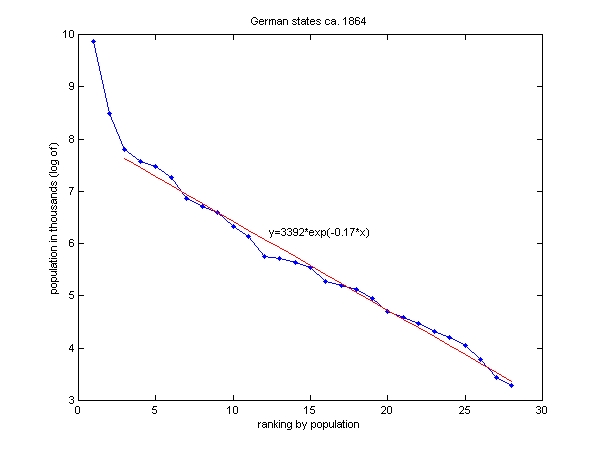
The states making up Germany varied greatly in size and importance,
although their numbers had been radically cut down when compared to the
pre-1806 Holy Roman Empire (see the table of size and
population).
The Deutsches Bund was created by a treaty of 8 June 1815 (Deutsche Bundesakte), which was included in the final act of the Congress of Vienna of the next day. (See the original text in German).
The 36 founding members were:
Several members disappeared through extinction: Saxe-Gotha was divided on 12 Nov 1826, Anhalt-Cöthen became extinct on 23 Nov 1847, and the princes of Hohenzollern-Hechingen and Hohenzollern-Sigmaringen ceded their soverignty to Prussia on 7 Dec 1849.
The count of Bentinck tried unsuccessfully to join as member by virtue of his possession of the lordhip of Kniphausen. A compromise reached on 8 June 1825 in Berlin with Austria, Prussia and Russia led to the count of Bentinck being awarded sovereignty over Kniphausen in the same relation with Oldenburg as it was with the former Empire and Emperor; Oldenburg represented Kniphausen within the German Bund. This partially sovereign status disappeared on 1 Aug 1854 when Kniphausen was formally ceded to Oldenburg.
In 1839, as a result of the secession of Belgium and part of Luxemburg from the Netherlands, part of the Dutch province of Limburg was declared to be held by the king of Netherlands as grand-duke of Luxemburg, with reversion rights to the agnates of the house of Nassau as for Luxemburg (treaty of London, 19 Apr 1839, art. 3: "[...] there shall be assigned to HM the king of the Netherlands, Grand Duke of Luxemburg, a territorial indemnity in the Province of Limburg"; art. 4: "...HM shall possess, either to be held by him in his character of Grand Duke of Luxemburg, or for the purpose of being united to Holland, those territories [etc]" which represent the modern Dutch province of Limburg, less Maastricht; art. 5: "HM the King of the Netherlands, Grand Duke of Luxemburg, shall come to an Agreement with the Germanic Confederation, and with the Agnates of the House of Nassau, as to the applications of the stipulations contained in articles 3 and 4 [...]"; see Hertslet, vol. 2, p. 983; the Confederation ratified the treaty on 5 Sep 1839 and the agnates of the house of Nassau signed a convention on 27 June 1839; ibid., p. 1001).
After the "War of the Duchies" Denmark lost Holstein and Schleswig (30 Oct 1864) and effectively ceased to be a member.
The Confederation survived until it was torn apart by the conflict between Prussia and Austria. On 14 June 1866, the Prussian government declared the Confederation to be dissolved and declared war on Austria. The ensuing war resulted in a rapid and crushing victory for Prussia. Austria was defeated and signed the peace of Prague (23 Aug 1866) recognizing the end of the Confederation. The king of Prussia annexed Hanover, Electoral Hesse, Nassau and Frankfurt (bill submitted to the Prussian Landtag on 16 Aug 1866, ratified by same on 20 Sep 1866). Later, it formally annexed Holstein and Schleswig, Hesse-Homburg (whose landgraves had become extinct in male line on 24 Mar 1866), and portions of Bavaria and Hesse-Darmstadt (24 Dec 1866). Limburg returned to its former status as integral part of the Netherlands (treaty of London, 11 May 1867).The North German Confederation (Nord-deutsches Bund) was formed by treaty of 14 June 1867. (See the original text in German). It included Prussia, Saxony, Mecklenburg-Schwerin, Saxe-Weimar-Eisenach, Mecklenburg-Strelitz, Oldenburg, Braunschweig, Saxe-Meiningen, Saxe-Altenburg, Saxe-Coburg-Gotha, Anhalt, Schwarzburg-Rudolstadt, Schwarzburg-Sonderhausen, Waldeck-Pyrmont, Reuß elder line, Reuß younger line, Schaumburg-Lippe, Lippe-Detmold, Lübeck, Bremen and Hamburg.
| Date | ruler | state | issue | date |
|---|---|---|---|---|
| 11/11 | Friedrich August | Oldenburg | 268 | 12.11 |
| 11/11 | Heinrich XXVII | Reuß j. L. | 268 | 12.11 |
| 12/11 | Joachim Ernst | Anhalt | 269 | 13.11 |
| 12/11 | Leopold | Lippe | 269 | 13.11 |
| 13/11 | Ludwig | Bayern | 270 | 14.11 |
| 13/11 | Friedrich | Waldeck | 270 | 14.11 |
| 14/11 | Karl Eduard | S-C-G | 271 | 15.11 |
| 14/11 | Friedrich Franz | Mecklemburg-Schwerin | 271 | 15.11 |
| 15/11 | Adolf | Schaumburg-Lippe | 272 | 16.11 |
| 22/11 | Friedrich II | Baden | 278 | 25.11 |
| 28/11 | Wilhelm II | Prussia | 283 | 30.11 |
| 30/11 | Wilhelm | Wurttemberg | 284 | 2.12 |
| State | Population | Size |
|---|---|---|
| (thousands) | (km2) | |
| Preußen | ||
| Preußen (ante 1866) | 19,303 | 280,194 |
| Hannover | 1,924 | 38,546 |
| Schleswig-Holstein | 960 | 17,545 |
| Kur-Hessen | 737 | 9,518 |
| Nassau | 466 | 4,685 |
| Frankfurt | 89 | 100 |
| Hessen-Homburg | 27 | 261 |
| Boundary adjustments | 80 | 1,260 |
| Preußen (post 1866) | 24,039 | 352,201 |
| Norddeutscher Bund | ||
| Sachsen | 2,423 | 14,967 |
| Mecklenburg-Schwerin | 561 | 13,441 |
| Oldenburg | 315 | 6,400 |
| Hamburg | 305 | 409 |
| Braunschweig | 303 | 3,690 |
| Sachsen-Weimar | 283 | 3,635 |
| Hessen-Darmstadt (Oberhessen) | 257 | 3,314 |
| Anhalt | 197 | 2,320 |
| Sachsen-Meiningen | 180 | 2,476 |
| Sachsen-Coburg-Gotha | 169 | 1,969 |
| Sachsen-Altenburg | 141 | 1,321 |
| Lippe-Detmold | 111 | 1,134 |
| Bremen | 109 | 257 |
| Mecklenburg-Strelitz | 98 | 2,725 |
| Reuß (jüngerer Linie) | 88 | 829 |
| Schwarzburg-Rudolstadt | 75 | 968 |
| Schwarzburg-Sonderhausen | 67 | 860 |
| Waldeck-Pyrmont | 57 | 1,121 |
| Lübeck | 48 | 286 |
| Reuß (älterer Linie) | 44 | 274 |
| Schaumburg-Lippe | 31 | 443 |
| Süddeutschland | ||
| Bayern | 4,824 | 75,836 |
| Württemberg | 1,778 | 19,450 |
| Baden | 1,434 | 15,284 |
| Hessen-Darmstadt (Starkenburg, Rheinhessen) |
566 | 8,392 |
Prussia accounts for 62% of the German population (50% before 1864).
Prussia, Bavaria, Baden, Württemberg and the kingdom of Saxony account
for 89% of the population.
Intriguing, eh?