SOME MEDIEVAL TREATISES ON ENGLISH HERALDRY
By H. Stanford London, F.S.A.
Antiquaries Journal 1953 33:169-183.
[169]
The object of this
paper is to invite attention to some early treatises on English
heraldry in the hope of stimulating interest in that somewhat neglected
phase of this study. None of the manuscripts in question has been
printed, but first it may not be amiss to recall briefly the half-dozen
tractates which have been printed.
Whatever his shortcomings as a king of arms, English heraldry owes Sir Edward Bysshe a debt of gratitude for his publication of Nicholas Upton's treatise De Studio Militari and Johannes de Bado Aureo's Tractatus de Armis.(1) The Tractatus was written about 1394; the De Studio some fifty years later, about 1440; but neither was printed until Bysshe's edition appeared in 1654. In the meantime, however, The Boke of St. Albans, printed in 1486, had included a section on heraldry
which is based in large measure on Upton.(2) For most of us our knowledge of
medieval heraldry books is limited to those three works, and their contents are not
such as would tempt one to
delve farther into that phase of heraldry. The insistence on such
subjects as the meaning and precedence of colours and beasts is to
themodern mind sheer nonsense, while the Anglo-Latin affected by Upton
and de Bado Aureo is difficult and repellent to all but experienced
medievalists. The next medieval heraldry book to be printed is a
metrical treatise in Lowland Scots written in 1494 by a Scottish
Pursuivant named Loutfut. I say 'written', for there is no proof that
Adam was more than the copyist. Nevertheless it is likely enough that
the verses were composed or translated by him, for he says expressly
that another tractate, now alas lost, was translated by him from the
French. These verses were printed by the Early English Text Society in
1869, but as the bulk of the volume containing them has nothing
whatever to do with heraldry they have attracted no attention from
armorists; they are not even mentioned in Gatfield's Guide to Heraldry. I refer to them again presently.(3)
No other medieval textbooks were printed for nearly a century, but in 1945 our Fellow, Professor Evan Jones, published Medieval Heraldry. This includes five separate and distinct treatises, while the introduction also contains some pertinent remarks about Upton's De Studio. And here I should like to say how grateful I am
[170] to Professor Jones for his
help in connexion with this paper, especially in decipher ing,
interpreting, and transcribing some of the manuscripts; two in
particular are written in an extraordinary jumble of English, French,
and Latin.
The first of the five treatises in Professor Jones' book is one in Welsh called Llyfr Arfau, the Book of Arms. This is based primarily on the Tractatus of de Bado Aureo.
The second is a new edition of the Tractatus itself.
The third item I have named
the Pakenham tract from the earliest known owner of the manuscript.
According to the preamble it was compiled in 1449 from the Tractatus and
other books. It is a muddled and incompetent production and would be of
no importance but that it contains some terms which have not been found
any earlier treatise. (One of these was overlooked by Professor Jones
in his efforts to reduce the chaos of the manuscript to some sort of
order.)
There is a strong family likeness between Upton and those three treatises, the Tractatus, the Llyfr Arfau, and
the Pakenham tract, and the unprinted Dublin tract belongs to the same
group. Professor Jones' fourth item, however, break new ground. It is a
little English 'Tretis on Armes' whose writer names himself in the
preamble 'John'. By an unlucky concatenation of circumstances Professor
Jones was led to extend that as 'John Vade'. That suggestion is
inadmissible; it was based largely on the belief that a manuscript in
the Bodleian Library, Laud Misc. 733, is a copy of the same tract
whereas in reality it is merely an English version of de Bado Aureo's Tractatus. Owing
to the Second World War Professor Jones was unable to inspect that
manuscript, but our Fellow, Mr. P. S. Spokes, has recently examined it
for me and he confirms that it is the Tractatus in English. Indeed the colophon says as much : EXPLICIT BREVIS TRACTATUS DE ARMIS DECLARANDIS SECUNDUM MAGISTRUM JOHANNEM DE VADE AURIO CUM FRANCISCO DE FOVYS. It
will be noticed that according
to that colophon the author's name is neither 'John Dade' as Dallaway
said, nor 'John Vade' as Professor Jones was led to believe, but
'Johannes de Vade Aurio', that is de Bado Aureo himself. I must also
differ from Professor Jones in regard to the manuscript Harl. 6097
which he saw as a copy of John's 'Tretis'. It is true that the two
tracts begin in the same way but the Harley manuscript adds a great
deal which is not in John's 'Tretis' and in fact it is an Elizabethan
copy of a much longer compilation, the Heralds' Tract, which is
mentioned below.
Lastly, Professor Jones gave us the Tractatus de Insigniis et Armis of
Bartholus de Saxo Ferrato. Bartholus was an Italian lawyer who died in
the 1350's and his tract has nothing to do with English heraldry except
in so far as the uses and customs of heraldry in the fourteenth century
were common to the whole of western Europe. Bartholus, however, enjoyed
a high reputation in those days and his works and those of Francis de
Foveis are quoted as authoritative in nearly all the fifteenth-century
treatises known to me. We must therefore be grateful to Professor Jones
for reprinting the De Insigniis in this handy form. Of
Francis's work no copy has yet been identified, but it may well be that
one of the many manuscripts catalogued as copies of de Bado Aureo's
tract will prove on closer examination to be Francis's lost work. It is
an interesting point that although Francis is so often quoted I have [171] to find (apart from the preface to the Pakenham tract) any reference to de Bado Aureo or to any work which might be identified as the Tractatus.
Leaving the printed treatises
I now turn to some which are not yet in print; I say 'some', for the
handful known to me were all found accidentally during the search for and work on early
rolls of arms in connexion with the new 'Papworth'. There are certainly
others, perhaps many others. Of the unprinted tracts listed in the
appendix some were found by Mr. Wagner, some by myself, and one,
Patrick's book, was found by Professor Roger Mynors in Antwerp.
Of those to which I now particularly invite attention one, the Dublin tract, belongs to the Tractatus group.
Its compiler must have drawn on the same sources as Upton and the
writer of the Pakenham tract, but in view of the many variations in the
order of the sections it is unlikely that he used either of those
manuscripts. The other treatises fall into two groups of which I take
the Ashmolean tract and Strangways' Book as the eponymous members.
And here it will be well to interject a few words as to the names by which I refer to the tracts. Mr. Wagner pointed out in his Catalogue of English Medieval Rolls of Arms that
the practice of giving names to rolls began centuries ago and the more
one works on them the more one feels the need for distinctive names. So
too with the tracts. The need for distinctive names was immediately
apparent, but as such names convey nothing to the uninitiated I append
hereto (page 182) a list of all the tractates at present known to me.
That list serves also as a key to the short references by which the
tracts may be cited.
The first of the two groups to
which I have just alluded comprises four tracts : tie Ashmolean tract,
John's 'Tretis on Armes', the Bradfer-Lawrence tract, and Loutfut's
poem.
The Ashmolean tract is so
named because it is written on the dorse of the Ashmolean Roll. It is
quite short, about 1,700 words. It begins with the story that armorial
bearings were first used at the siege of Troy and were brought to
England by the Trojan Brutus, but the rest is a straightforward account
of some tinctures and charges used in armory with a few rules as to
their blazoning. I shall not attempt to summarize it, for the greater
part is almost word for word the same as John's 'Tretis', and that was
printed by Professor Jones in Medieval Heraldry. We may,
however, notice the statement that if a man who bears a border about
his , arms impales his wife's coat the border must be omitted along the
party line. That is still the rule today and it is interesting to find
it stated so explicitly at that date. Among some uncommon terms
illustrated in this manuscript we may note voider, delf, hewmette, and belly. Of these voider is
the rarest. Modern textbooks explain and draw voiders as shallow
flanches, that is flanches drawn with a curve of large radius, but here
the voider has perfectly straight sides, the arms 'sylver ij wydoures
gowlys' being drawn as though a red shield was charged with a very
broad silver pale (fig. 1). Of the other terms belly is a sort of vair in which the panes are bell-shaped (fig. 2), and a hewmette is a hamaide, that is a bar with the ends cut off parallel to the edge of the shield (fig. 3d). The delf is drawn
here as a billet whose longer sides are slightly concave (fig. 3b), but
other manuscripts of much the same date draw the delf as a square
billet (fig. 4).
[172]
As to the date of this tract, both the Ashmolean manuscript and John's 'Tretis' are
written in a mid-fifteenth-century hand and that is probably when the
tract was composed. I was at one time inclined to think that it was
composed but little later than de Bado Aureo's Tractatus, say at the end of the fourteenth or beginning of the fifteenth century. I have,
however, found nothing which necessitates so early a date, On the
contrary the fact that the tract gives the special names for the
different coloured roundels is a strong argument against it, for those
names are given nowhere else before the middle of the fifteenth century
and they did not come into general use until the sixteenth century. It
is also to be noted that the cadency stigmata are given in the same
order as in modern usage: label, crescent, molet,
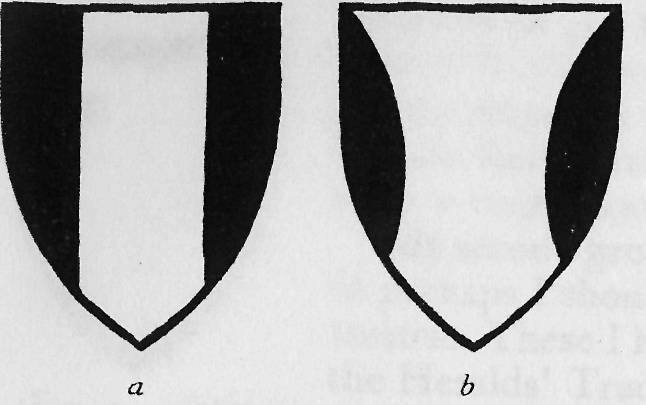
Fig. 1. Voiders. Argent, two voiders gules,(a) after the Ashmolean and other tracts ; (b) according to modern textbooks. |
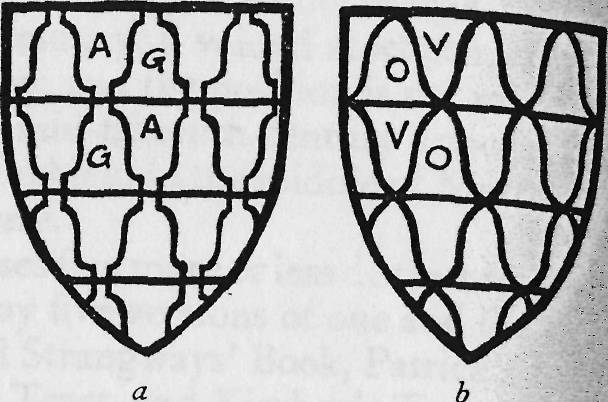
Fig. 2. (a) Belly silver and gules; (b)Vairy gold and vert, after the Heralds' Tract fo 5 b
|
|
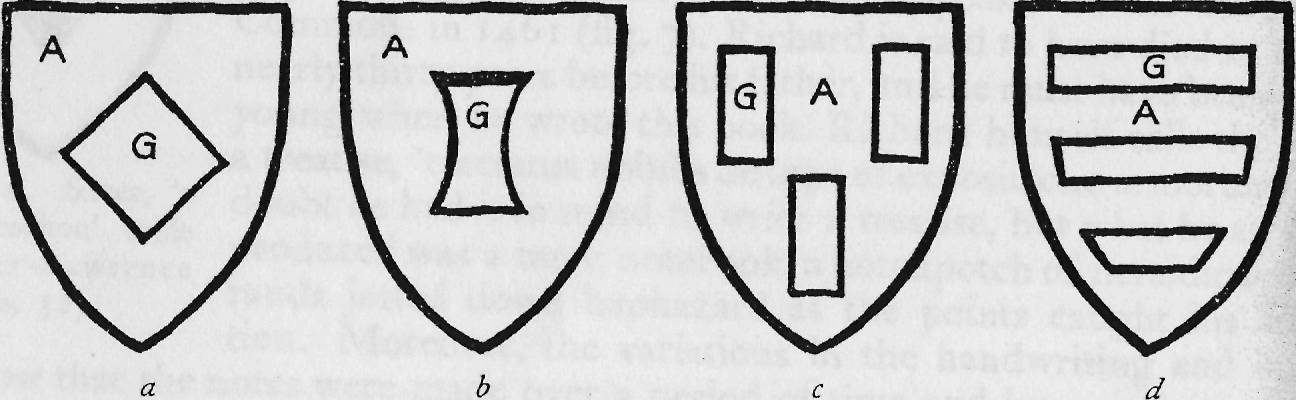
FIG. 3. (a) Silver, a pitte gowlys; (b) Silver, a delfe gowlys; (c) Silver, 3 billettes gowlys; {d) Silver, 3 hewmettes gowlys, after the Ashmolean Tract.
|
martlet, annulet, and
fleur-de-lis. It is true that those and other petty charges were used
as differences as early as the 1390's, but they are not mentioned by de
Bado Aureo or Upton or even in the Pakenham tract, and I can find no
evidence that they were used with their present numerical value before
Tudor times. Spelman indeed says that the system was inventum et profagatum by John Wrythe (Garter 1478-1504) in the reign of Edward IV (Aspilogia, ed.
Bysshe, p. 140). It is hardly likely that Wrythe invented the system,
but at least the statement shows that to the Eliza-bethans it was of no
great antiquity.
[173]
I I have included Loutfut's
verses in this group because the main portion is a translation, not
always accurate, of the Ashmolean or some similar tract. On the other
hand, the preliminary section about the invention of coat-armour is
more elaborate than in any of the other manuscripts and the poem ends
with fifty lines or so glorifying the heralds.
I have not seen these elsewhere and they may well be Loutfut's own
work; he was himself Kintyre Pursuivant, and he wrote out this and
other tracts at the behest of Sir William Cumming, then Marchmont
Herald and afterwards Lyon King of Arms.
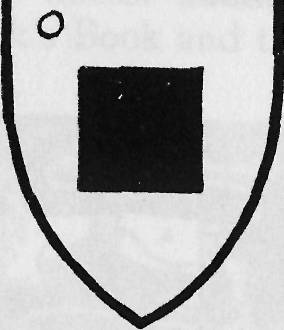
Fig 4. Gold, a delfe sable, after the Heralds' Tract, fo. 5 b. |
The Bradfer-Lawrence tract
seems to be a unique and original compilation of mid-fifteenth-century
date. It is the third of the seven sections which make up the roll or
book which Mr. Wagner named after our Treasurer, its present owner. The
handwriting is the same as in section II, and that can be dated from
internal evidence at 1445 or soon after. A description of the whole book is in Mr. Wagner's Catalogue.(1) The
tract was probably compiled by a Yorkshireman. The references to
Stapleton and Ingham (unfortunately mutilated by the loss of half a
leaf) might point either to Yorkshire or Norfolk, but Professor Bernard
Colgrave considers that the dialect, though not very distinctive, shows
northern and midland influences, so Yorkshire is the more likely. The
tract contains many passages which are also in the Ashmolean
manuscript, but these are paraphrased and often much condensed, whilst
there are many other passages which are not to be found in any version
of the Ashmolean tract.
It is worth remarking that
this tract, unlike some other manuscripts, is careful to distinguish
ermine (white with black spots) and erminees (black with white spots).
It calls the one ermyn and the other ermyne; the final e should no doubt be pronounced.
Two other passages peculiar to
this tract must also be noticed. The figures illustrating these are in
the one case an engrailed border and in the other an inescocheon. Of
the former it is said that if a man bears a scocheon of gules with an
engrailed sable border some would blazon it (just as we should now) :
Gules, a border engrailed sable, but others prefer to say: Sable, a
voide of gules engrailed (fig. 5). I do not recall seeing voide used in that sense anywhere else.
Of the inescocheon the tract
says that in some arms there is a false scocheon, that is to say a
little scocheon within the principal shield (fig. 6). Here the
interesting word is 'false'. In thirteenth-century blazon 'false'
meant voided. So in Glover's Roll an annulet is called a false roundel;
false lozenges and false scocheons occur both in Glover's and in
Walford's Roll, and false scocheon in the sense of voided scocheon, the
orle of modern textbooks, is used so late as 1298 in the Falkirk Roll.
[174]
The term, however, disappeared
soon after, and in 1322 the Boroughbridge Roll uses 'fauz escuchon' to
blazon the silver scocheon in the well-known coat of Morti-mer. So too
in the fifteenth century, Thomas Jenyns' Book, for instance, calls an
inescocheon a false scocheon, fans escuchon, and blazons the Balliol charge, the false scocheon of the thirteenth century, a voided scocheon, escuchon voide.(1) It
is all very confusing, and the position is not made any clearer when we
find that a mid-fifteenth-century armorial, the Dublin Roll, blazons
the little shield in the middle of Mortimer's arms a voide scoychion of silvere.
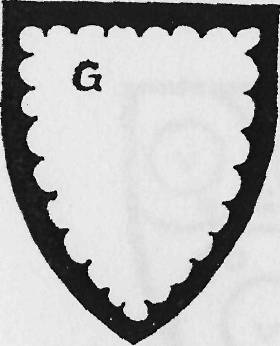
Fig.5.
'Sabyl a voide of goules
engrlid, and somme seyn goules a bordure of sabil engrelid' (Bradfer-Lawrence Tract, fo. 23).
|
My second group comprises five
more or less distinct treatises or perhaps I should rather say five
versions of one and the same treatise. These I have named Strangways'
Book, Patrick's Book,
the Heralds' Tract, Povey's Tract, and Kimbey's Tract. There are also some extracts from this in John Wrythe's Garter Book and in Peter Le Neve's Book. These extracts consist of painted shields with accompanying legends and were evidently
chosen as illustrating terms of blazon. They are
mentioned in the appendix as the Wrythe-Strangways
shields and the P.L.N. shields, and at that we can leave them.
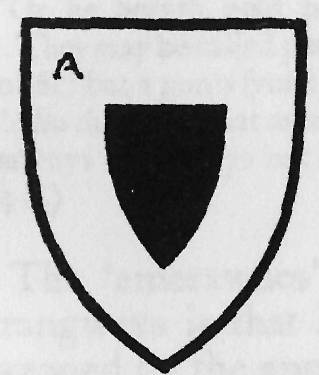
Fig.
6. Silver, 'a faws scochon' sable (Bradfer-Lawrence Tract fo 12) |
Of the five tracts or versions
the earliest and the fullest is Strangways' Book, MS. Harl. 2259. This
was written in the 1450's by Richard Strangways of the Inner Temple,
whom I take to be the eldest of the twenty children of Sir James
Strangways of Harsley Castle, Yorkshire, Speaker of the House of
Commons in 1461 (fig. 7). Richard is said to have died in 1488, nearly
thirty years before his father, and he must have been quite young when
he wrote this book. Richard himself calls the book a treatise, 'tractatus nobilis de lege et exposicione armorum'. No doubt he had it in mind to write a treatise, but what he
actuallyproduced was a mere notebook, a hotchpotch of
heraldic memoranda jotted down haphazard as the points caught his attention. Moreover, the variations
in the handwriting and in the ink show that the notes were made over a
period of time and by no means always consecutively. As to the source
of the notes, Strangways says that the book was 'ex pluribus libris
aggregatum', and that is obviously so. Not only does he begin with a
long passage from the Ashmolean tract but references to Bartholus and
Francis de Foveis are frequent and many other passages are evident
quotations, one at least coming from Justinian's Digest of the Civil
Law. Moreover, and this is very pertinent, he refers in a short
foreword to his teacher, his 'doctor qui quidem in hac lege suis
temporibus floruit sine pare'. He does not name this 'doctor', but the
frontispiece of the book is a large painting of the arms of one Thomas
Dereham, apparently one of the Norfolk Derehams, for the arms are,
Azure, a buck's face gold, [175] quartering Argent, a cross
gules. I have found no one of that name in the Strangwavs pedigree and
I suspect that he was the 'doctor', at a guess a professor of heraldry
lecturing near the Inns of Court.
Had Strangways' Book stood alone we
need not have given this 'doctor' another thought, but there are four
other versions. Two of these, Patrick's Book and the Heralds' Tract,
date from about 1460, that is only a year or so after Strangways' Book.
The other two, Povey's and Kimbey's Tracts, I take to be Elizabethan or
thereabouts. There is also an Elizabethan copy of the Heralds' Tract in
MS. Harl. 6097. None of these is a complete or exact copy of Strangways'
Book and they differ widely both in the choice and order of the items
and in the colouring of the illustrative shields, as well as in other
minor respects. At the same time it is manifest that all stem from a
common source. Convinced as I am that Strangways' Book is Sir Richard's
own handiwork and that it is in large measure an original compilation,
my first idea
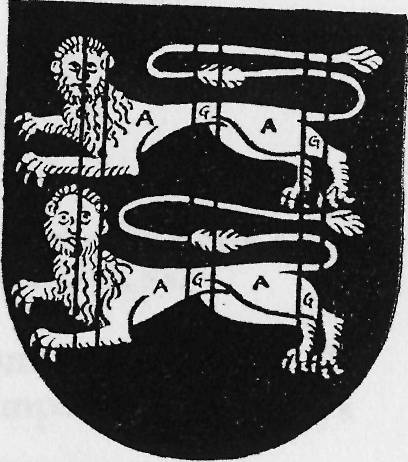
Fig. 7. Arms of Sir James
Strangways. 'He beryth sabyll ij lyonceux passant sylver gowlyd in iij
endocerys' (Strangways' Book, fol 53 b). |
was that it—Strangways' Book—was the fount whence the other four manuscripts
drew their inspiration; but the more I considered the problem the more
I felt that the whim of an editor is too
flimsy a reason to explain the many variations. For the same reason I rejected the idea of an undiscovered tractate as source at once of Strangways' Book and of the other
tracts. In the end I concluded that the common source of these five tracts can only
have been Strangways' 'doctor', and I explained their variations, at least to my own satisfaction, by supposing that they were the work of or based on the notes
of different pupils. I can think of no theory which will better explain both the likenesses and the differences between the versions. (2)
As a collector of the queer terms and turns of blazon with which the fifteenth-century theorists befuddled armory Strangways has no rival. He himself calls these terminos extranios; modern readers may translate that 'outlandish jargon'. Many of
those terms were probably never used and they have little interest except as curiosities. Such, for instance, are sabatyned and soleux (or should it be solenx? [176] The manuscript can be read either way). Strangways blazons fig. 8:
'gold saba-tynyd wit gowlys iij emerawdes in the feld', and he explains
that it is like the shoes worn by bishops at high mass, which, he says,
are called 'sabatynys' because they are worn on the sabbath. It will be
noticed that Strangways likens the red portion of the shield to the
shoe although there is no resemblance whatever that I can see. whereas
the gold corner-pieces do vaguely suggest the bulbous-toed shoes which
were worn a little later in the century.(1)
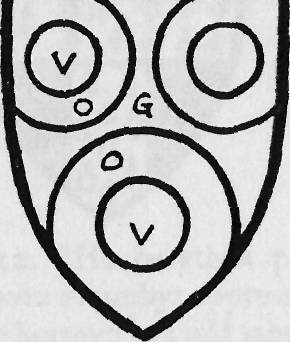
Fig. 8. 'He
beryth gold sabatynyd wit gowlys iij emerawdes in the feld. Thys ys
leke to a byshoppys sho that he weryth on festfull dayys at hys masse
and the shoys be callyd sabatynys quia utuntur in sabato.
'Or he
beryth gold pontyficalyd wit gowlys etc. They may be callyd
pontyfycallys quia servunt pontifici but a pontyfycall ys hys ryng
properly.
'Also the plates that arme menys fete ben callyd sabatynys but that ys nat her proper name.' (S. 174. b.)
|
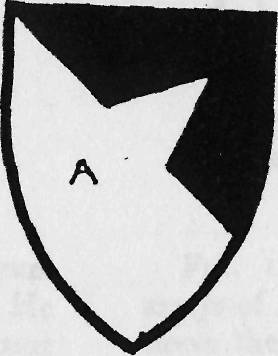
Fig. 9. 'Chambreleyn. He beryth
sylyer and sabyll in ij soleux overt. A soleux ys callyd the over leder
of a sho and therfor theys armys wer geve to the kynges sowter H. the vte the whech dwellyd in Lombard strete, and there be the armys yet.' (S. 70.)
|
The 'emerawdes' are merely green roundels. One of the whimsies noted by
Strangways is that if a coloured roundel is set in a gold field, then
it should be blazoned by the appropriate gem, emerald, ruby, sapphire,
diamond, or amethyst So the Povey's tract version of this coat which
paints the roundels black blazons hem diamonds. It was about this time
or a little earlier that Sicily Herald evolved he idea of substituting
the names of gems for the tinctures in blazoning—see Mr, Wagner's
Heralds and Heraldry, p. 106.
Soleux according to Strangways is the 'over-leather', or upper, of a shoe and the coat in fig. 9
was given to Henry V's shoemaker. In Strangways' day it was still to be
seen in Lombard Street where the man lived. The coat is blazoned:
'Sylver and sabyll in ij soleux overt.' The name written above it is
Chambreleyn, but it is very faint and is in a large sprawling hand
unlike Strangways' usual script; it does not appear in the other copies.
Some queer terms are also to be found among the lions and crosses. Of the lions in fig. 10, for instance, the one holding up his hand like a schoolboy in class is [177] blazoned
a lion seyaunt in cowche ove bowche & dextre pe comme rampaunt'.
The 'next, with his mouth tight shut, is 'le bowche muett comme
rampaunt', while the last, hiding behind a big
shield or pavise, is a 'lion paveysed comme rampaunt'. It will be
observed that these lions are not rampant but comme rampant. Strangways
and his fellows would not allow a lion to be blazoned rampant unless he
was represented in the fiercest possible guise as in the arms of
Peche, fig. 11. That coat may be blazoned quite simply as: Azure, an
ermine lion with tail forked in saltire and a gold crown. Strangways'
blazon is: 'asur a lyon rampaunt hermyn cue mascle forche hersle
rehersle crownyd langyd & enarmyd gold'. Hersle and rehersle refer
to the tufts of the tail which are turned respectively outwards
{hersle') and inwards (rehersle). According to Strangways these arms
were given by Henry V to Sir William Peche for coming to his rescue in
France, and the king used to recall the incident by adding at the end
of his letters: 'Ho so, love me, love well Pecche.'
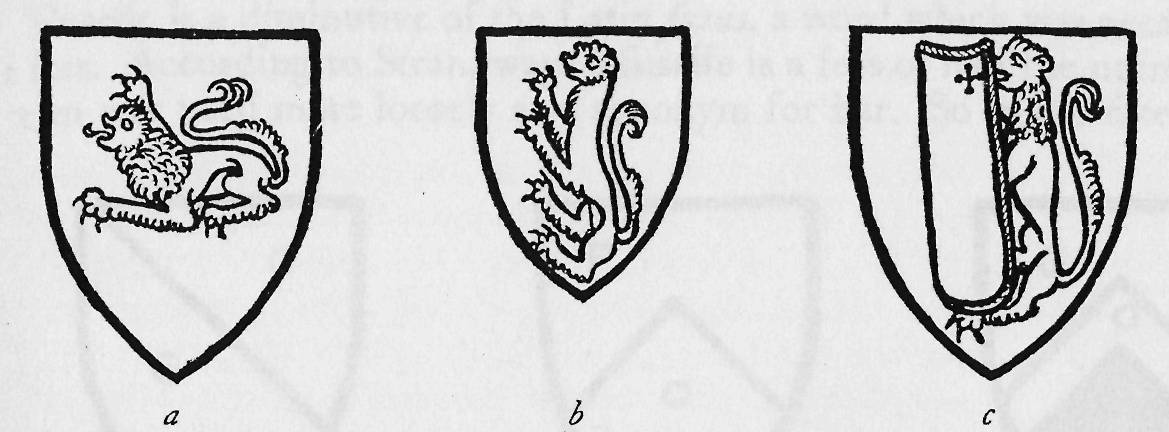
Fig. 10. (a) 'Un lion seyaunt in
cowche ove bowche & dextre pe comme rampaunt'; (b) 'Un lion le
bowche muett comme rampaunt'; (c) 'Un lion paveysed comme rampaunt.'
(S. 62.)
|
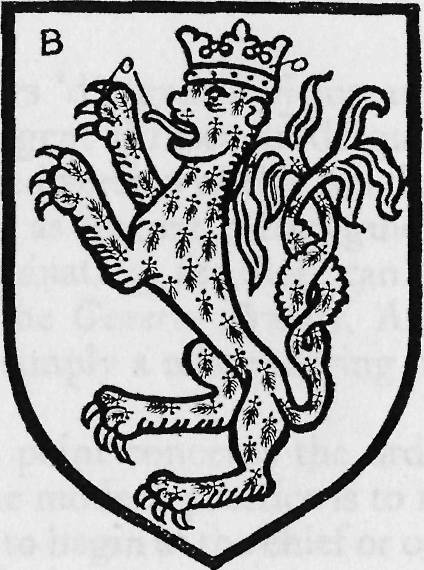
Fig. 11. 'Wylliam Pecche. He beryth
asur a lyon rampaunt hermyn cue mascle forche hersle rehersle crownyd
langyd & enarmyd gold. Thys was Pecche thatsoccoryd Kyng H. the vte
in Fraunc by the wych he gat theys armys & was made knyght by the
Kyng, & of hym was that proverbe whych the Kyng usyd in every
lettyr that he made to any lord & in other places, that ys to say:
Ho so, love me, love well Pecche.'(S. 115 6.)
|
Most of Strangways' examples seem to be ad hoc inventions; many are
imitations of genuine coats and some, like the soleux, were, it
appears, actually seen and noted by Strangways in London. Fig. 12
is another which he himself saw. It was in St. Martin's le Grand.
Strangways does not name it, but it is the arms of Nott-yngham. John de
Nottyngham was Treasurer of York Minster from 1415 to 1418 and his arms
appear several times in the windows there. In John Brown's book on the
York glass the gouts are coloured a pale pink, quite unlike the solid
red which he uses for gules ; it is therefore all the more interesting
to see that Strangways blazons them in umbre. His full blazon is : 'a
pale sylver gowte in umbyr appressyd wit a barr hermyn in a feld
sabyll'. It would be interesting to know whether the [178] gouts
are still visible in the York glass, but the shields were removed for
safety during the war and have not yet been replaced.
Unlike the Nottyngham coat figs. 13 and 14 are
named, but I should hesitate describe either as genuine. The one is
attributed to Sir John Mandeville : 'Mawndvyle chevaler maximus
peregrinator. He beryth a squar frett frette asur & goules in
sylver.' The coat has not been found except in versions of this tract,
and in the later versions of the so-called Mandeville Roll in which it
has been interpolated from this tract. The square fret, as Strangways
calls it, is a very rare charge. Dr. Adam has found it two or three
times in French rolls and he tells me that the contemporary French
blazon was grille or treillis. The only square fret which I have found
in an English roll is an unnamed shield in Randle Holme's Book:
'Argent, a square fret sable and on a chief sable three mallets
silver.' That is probably a foreign coat, for the mallet is commoner in
continental than in British armory and Randle Holme's Book contains a
good many continental coats.(1)
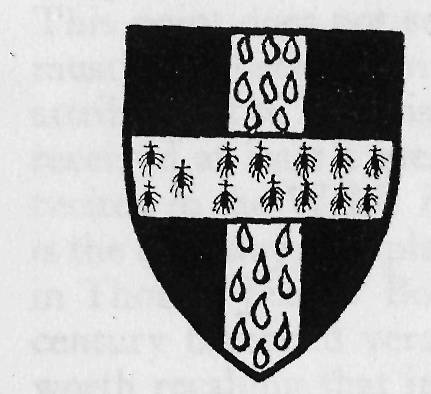
Fig. 12. 'He beryth a pale sylver
gowte in umbyr appressyd wit a barr hermyn in a feld sabyll. Vide
apudecclesiam Seynt Martin Graund.' (S. 126 A) [Arras of John de
Nottyngham, Treasurer of York Minster 1415-18.]
|
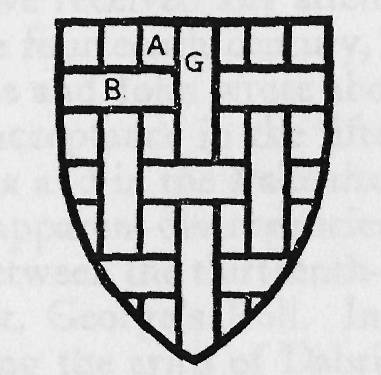
Fig. 13. 'Mawndvyle chevaler maximus peregrinator. He beryth a squar frett fertte asur & goules in sylver.' (S. 90.)
|
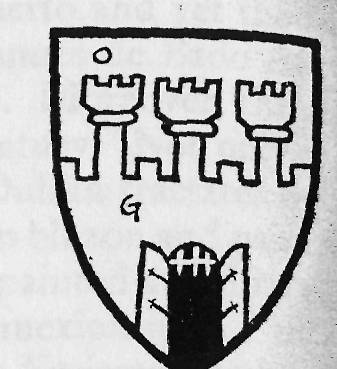
Fig. 14. Theys be the armys of the
gret Turke that slowe the emperor of Con-stantyne nobyll a0 dni
moccccolvj°. He beryth golda castell trebyll towryd goulys the port
dysplayed of the feld & portcolysed sylver.' (S.45.)
|
Fig. 14 I also take to be pure fiction : 'Theys
be the armys of the Gret Turke that slowe the emperor of Constantyne
nobyll a° d'ni m°cccc°lvj°. He beryth gold a castell
trebyll towryd goulys the port dysplayed of the feld & portcolysed
sylver.'
The foregoing extracts have been chosen primarily as curiosities, but
there is much in Strangways' Book which is of practical importance for
the student of Tudor and pre-Tudor armory. It is, for instance, just as
well to know that in the fifteenth century a gemelle was a single bar
of one-quarter the normal width so that the arms of Spygurnell which
are now blazoned, Azure, 3 bars or, then appeared [179] as
'asur iij gemellys gold', and what we now describe as 2 gemel bars were
then blazoned 'iiij gemellys in ij barres' (ff. 184b, 160). The word
fusel/e is another trap for the uninitiated who not unnaturally assume
that it is the same as fusil, the elongated lozenge, fuseau or fusew in
Strangways' day. Fuselle is a diminutive of the Latin fusus, a word
which was occasionally used for a fess. According to Strangways a
fuselle is a fess of half the normal width but the term was used more
loosely as a synonym for bar. So in the fifteenth-century blazoned
version of St. George's Roll Stoteville bears 'd'argent a vj fuseaulx
de gueulles' (186) and Nychol de St. Martin bears 'd'argent ij fuseaulx
de gueulles et v labels d'asur' (246). The thirteenth-century painted
version of this roll depicts the one coat as Burely argent and gules
and the other as Argent, 2 bars gules and a label azure. This latter
example is particularly illuminating, for there can be no doubt but
that the coat attributed to St. Martin in the General Armory, Argent, 2
fusils in fess gules and a label of 5 points azure, is simply a
misrendering of the fifteenth-century blazon.
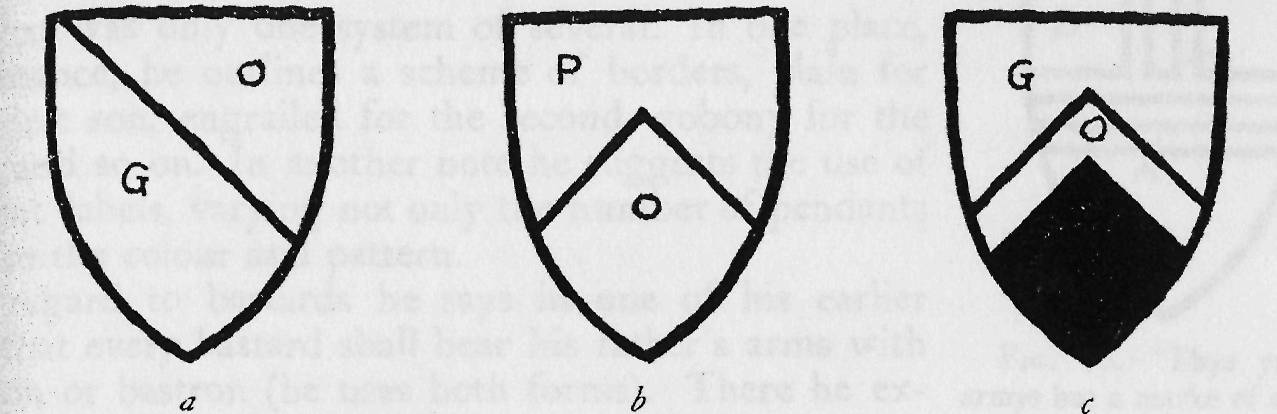
Fig. 15 (a) 'He berithe gowles and
owre party per bendy'; (b) 'He berith golde & purple party per
cheveron'; (c) 'He berithe sabules & gowles party be a cheveron
golde'. (H. 2 b.)
|
Another, and in some ways even more important, point concerns the order
in which the tinctures are to be named in blazoning. The modern
practice is to name the tincture of the field first and if that is
particoloured to begin at the chief or on the dexter side as the case
may be. Strangways, however, insists that that tincture must be named
first which runs down to the base point of the shield, the conus,
whether it be field or charge. In such blazons as A pale sable in a
field silver, or A cross 'gules in a field of silver, and even in many
more elaborate coats there can be no ambiguity, but in the case of some
patterned fields knowledge of this rule is capital. In fig. 15,
for example, the first shield is blazoned Gules and or party per bend;
a modern herald would naturally paint the shield with the gules in
chief but Strangways puts it in base. Similarly the second shield is
blazoned Gold and purple party per cheveron, but it is painted with the
purple in chief. So also in Sable and gules parted by a cheveron gold,
the red is in chief and the black in base. Another example of this is
the coat in which William the Conqueror is said to have invaded
England. Strangways, who mentions this several times, blazons it
'sylver and asur barryd in vj', but he paints it with the blue stripes
above the white (e.g. fo. 95b).
[180]
Actually there seems to
have been some uncertainty about the coat (was that due to ignorance of
this trick of blazon ?), for in a picture of William stepping ashore
before the Battle of Hastings he wears a surcoat with fourteen stripes
instead of the six specified by Strangways and the white bars are on
top. That painting serves as frontispiece to a series of pictures of
the kings of England which was painted about 1445 for the then
Clarenceux King of Arms, Roger Legh (MS. Harl. 4205, fo. 1b). This
point does not seem to have received any attention hitherto and yet the
rule must have been invented in the fourteenth century, for Johannes de
Bado Aureo attributes it to Francis de Foveis and John wrote about
1394. Moreover, the rule received at least a measure of acceptance in
the fifteenth century. Not only is it recited in the Welsh Llyfr Arfau
and in the Pakenham and Dublin tractates but it is the only way to
explain many apparent discrepancies between blazon and painting in
Thomas Jenyns' Book and between the thirteenth-century painted and
fifteenth-century blazoned versions of St. George's Roll. In this
connexion it is, I think worth recalling that in describing the arms of
Dabrichecourt Froissart counts the three hamaides from the bottom
upwards: 'sur Termine iij hamedes de gueules, sur la premiere hamede
une coquille d'or, sur la seconde deux coquilles d'or et sur le tierce
hamede trois coquilles d'or'. The idea of counting from the bottom
upwards also appears in France and that so early as 1254, for in the
Bigot roll a certain Arnoust de Holain bears 'un escu onde d'or et de
geules a ij faisses d'argent encastelees desox et deseure' (no. 83),
and Jehan Gravetiax bears 'l'escu d'ermine a une faisse noire a ij
listiax noirs, j dessox et l'autre deseure' (no. 100). So, too, in the
fifteenth-century copies of the thirteenth-century Armorial du
héraut Vermandois one finds such blazons as 'Burelé
d'argent et de gueules a iij papegaux de sinoble j dessoubs et ij
desseure' (no. 396), 'd'argent a ij faisses castelees desouls et
desseure' (353), and even 'de gueules a ung homme arme de pie en cappe'
(877), It may be that those and other similar blazons are due to the
fifteenth-century copyist, but in the light of the above items from the
Bigot roll I am inclined to think that they are survivals from the lost
thirteenth-century original.
So far I have spoken of nothing but armory, and indeed the other
versions contain little else, but Strangways was a member of the Inner
Temple, no doubt a student there, and he was no less interested in the
current theories of gentility, how acquired, how lost, and so forth.
The basic idea in his book is that a gentleman is one who wears
coat-armour of right; in other words, no arms, no gentleman. There ; is
of course much more to it than that, and the book would repay study for
the light: which it throws on the mentality of the age.
In regard to the acquisition of arms, Strangways draws a clear
distinction between arms and marks 'such as merchants use'. Anyone, he
says, may take a mark, but no one may take arms without the
intervention of a competent authority, that is either the prince or a
herald or pursuivant. On the practical side some held that a mark must
not have any metal in it whereas arms must include one of the metals,
silver or gold. So a red shield painted with a black lion or a blue
cross was a mark, but the same shield with either field or charge
changed to silver or gold would be arms. Strangways himself does not
seem to have accepted that view, for three different shields which he
dismisses as marks and not arms are painted either [181]
black and white or blue and white. Fig. 16, for instance, is painted
blue with white charges. Why Strangways rejected that as arms I cannot
say; his explanation explains nothing. In any case it was certainly
used as arms by a family named Churchman in the sixteenth and
seventeenth centuries, the charges being sable in a silver field or
vice versa.(1)
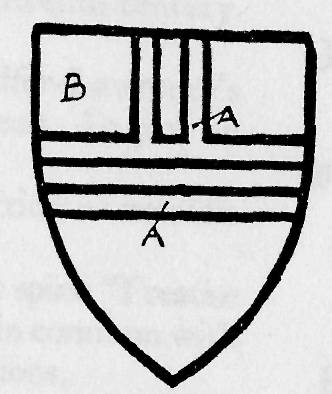
Fig. 16. 'Thys ys non armys but a marke of a marchaunt for yt ys to no
purpos as yt apperyth be all the lawe & rewles of armys' (S. 119
i). [This coat with the field sable was borne by Churchman in the 16th
century.]
|
Partaking alike of armory and of the more legal matter of gentility is
the question of differencing, and on that too Strangways has much to
say. In his opening passage he lists the cadency stigmata to which I
alluded in connexion with the Ashmolean tract, but other notes show
that that was only one system of several. In one place, for instance,
he outlines a scheme of borders, plain for the eldest son, engrailed
for the second, gobony for the third, and so on. In another note he
suggests the use of different labels, varying not only the number of
pendants but also the colour and pattern.
In regard to bastards he says in one of his earlier notes that every
bastard shall bear his father's arms with a baston or bastron (he uses
both forms). There he explains the baston as a narrow sinister
bend, but later he says that it may be either dexter or sinister and
that a bastard may either bear his father's arms with a dexter baston
or his mother's with a sinister. I have not seen that last notion
elsewhere, but the other two bastardy marks which Strangways records
are familiar enough. If, he says in one place, a bastard wears his
mother's arms the appropriate difference is a surcoat. So Gawain of the
Round Table, who was a bastard begot of a great lady, bore her arms,
Vert, a fess gold, with an ermine surcoat over all (fig. 17).(2)
If, on the other hand, a bastard wishes to bear his father's arms
he may set these in a bend and make the field of another colour; in
that case (this is a nice point which has eluded the modern manuals)
the field must be blazoned last, for it is no part of the arms but a
special sign. The example which Strangways gives, fig. 18, [182]
is blazoned, 'a bend sylver wit a cheveron gowlys betwyx iij pellettes
in a feld gold'. The arms on the bend are those of Borefeld, but
whether they were ever thus bastardized I cannot say. There are
many other points on which I should have liked to touch, but I hope I
have said enough to show that these early treatises contain much of
value and much of interest, not to mention some amusing touches.
Strangways' Book in particular is full of good things, and I can only
trust that someone, perhaps Professor Jones, will find the leisure and
the means to publish it in full with a suitable commentary.
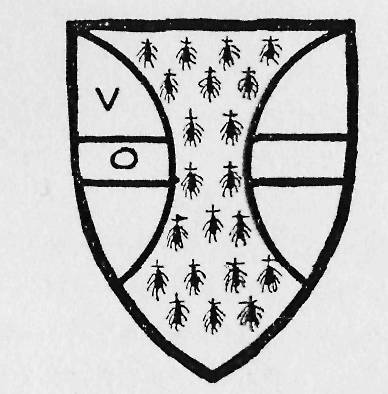
Fig. 17. 'Thys Gawyn
was a knyght of the rownde tabyll wit Kyng Arthur & he was a
bastard begot of a gret lady & her armys was vert a barr gold &
because he was a bastard he bar her armys wit this surcot as the lawe
of armys ys' (S. 73). |
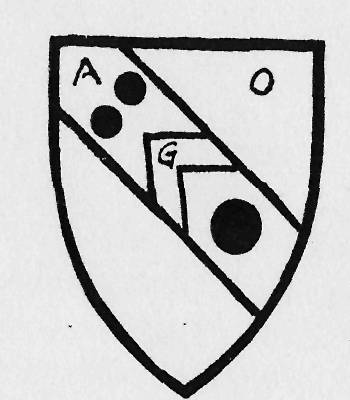
Fig. 18. 'A bend sylver wit
a cheveron gowlys betwyx iij pellettes in a feld gold. A bastard may
ber hys fadres armys in a bend & make the feld of an other color as
her. Thou shalt nat begynne to blase at the feld her for yt ys no part
of the armys but a specyall sygne as ys a bastron.' (S. 41.) [The arms
on the bend are those of Borefeld.]
|
APPENDIX
List of some Medieval Treatises on English Heraldry
Note. The initials in heavy type are the short references by which the items may be cited.
- Bartholus de Saxo Ferrato, De Insigniis et Armis. Published posthumously c. 1358. Printed by Bysshe in his notes to no. 5, pp. 4—17, and by E. J. Jones in Medieval Heraldry, pp. 224-52. Not English but often quoted in English treatises. B
- Franciscus
de Foveis. Fourteenth century. His teachings incorporated in no. 3 and
other works. No copy of his treatise yet identified.
- Tractatus de Armis. c. 1394. By 'Johannes de Bado Aureo' (alias 'John of Guild-ford'). Edited by Bysshe with no. 5 and by Jones, op. cit., pp. 95-143. Bodleian MS. Laud Misc. 733, c. 1500, is an English version. Professor Jones considers both this and no. 4 to be by John Trevor, bishop of St. Asaph 1394, ob. 1410. BA
- Llyfr Arfau (The Book of Arms). A Welsh treatise based primarily on no. 3. Edited with English translation by E. J. Jones in Medieval Heraldry, 1943,pp. 2-93. LL
- Nicholas Upton, De Studio Militari, c. 1440. Edited by Edward Bysshe, 1654, together with nos. 3 and 20. U [183]
- The Pakenham Tract. Add. MS. 28791, ff. 5-38. Medieval Heraldry, pp. 144-212. Compiled in 1449 from no. 3 and other sources. PM
- The Dublin Tract. MS. 7 in the Genealogical Office, Dublin, ff. 7-27b
(ff. 1-6 missing). Mid or late fifteenth century. May be an
abbreviation of no. 5 with additions from no. 6 and elsewhere and many
variations of order. DB
- The Ashmolean Tract. Bodleian MS. Ashmole Rolls 4 (formerly MS. Ashm. 15a). Mid fifteenth century. A
- John's Tretis on Armes. Medieval Heraldry, pp. 213-20. Mid fifteenth century. Shortened version of no. 8. JN
- The Bradfer-Lawrence Tract. 1445 or soon after. Part III of Bradfer-Lawrence's Roll (see C.E.M.R.A., p. 88). Probably written by a Yorkshireman. In part an abbreviation of no. 8. BR
- Strangways' Book. c. 1454. Brit. Mus. MS. Harl. 2259. A collection of heraldic memoranda by Richard Strangways of the Inner Temple. S
- The Heralds' Tract. MS. in the College of Arms. Lettered on the spine 'Treatise on Heraldry temp. Hen. IV, but not earlier than c. 1460. Has much in common with no. 11. MS. Harl. 6097 is an Elizabethan copy with minor variations. H.
- Patrick's Book. Post 1461. MS. C.B., 5.. 6 in the Plantin-Moretus Museum, Antwerp. Closely related to if not copied from no. 11. P
- The Wrythe-Strangways shields, c. 1480. Fifty-three shields in Wrythe's Garter Book, pp. 81, 164-9 (C.E.M.R.A., pp. 122, 123). Copied from a source nearly related to no.11. WS.
- The P.L.N. Shields, c. 1480-1500. Brit. Mus. MS. Harl. 6163, ff. 136-414 (C.E.M.R.A., p. 109, sub tit. 'Peter Le Neve's Book'). Extracts from no. 11 or a similar source. PN.
- The Boke of St. Albans. Printed 1486. Facsimile reprints 1810 and 1901. See also appendix to Dallaway's Inquiries, 1793.
Apparently condensed from no. 5. SA.
- Loutfut's poem. Metrical
treatise in Lowland Scots written in 1494 by Adam Loutfut, Kintyre
Pursuivant. Printed 1869 in Queene Elizabeth's Achademy and other pieces, Early English Text Society, Extra Series, no. 8. Translated from an English source akin to no. 8. LK.
- Povey's Tract. Mid sixteenth century. College of Arms MS. B. 19. An englished version of no. 11 or similar collection. PO.
- Kimbey's Tract. MS. Harl. 3526, art. 4. Late Elizabethan or early Jacobean compilation based on no. 11 or the like. K.
- Aspilogia by Sir
Henry Spelman (1564 ?—1641). Said to have been written when he I was
very young. Not medieval, but printed by Bysshe with no. 5. SP.
Footnotes
p. 169
1. De Bado Aureo has been englished as John of Guildford, and Professor
Evan Jones identifies him with John Trevor, bishop of St. Asaph 1394,
died 1410. The question of his identity is, however outside the scope
of this paper and I use the name de Bado Aureo as that under which this
tract is best known.
2. I say 'based on Upton' because I know of no earlier or fuller
treatise resembling the De Studio. But De Bado Aureo acknowledges his
indebtedness to Francis de Foveis, and Sir Richard Strangways
acknowledges his to his 'doctor', while the writer of the Pakenham
tract says expressly that that was collected from the Tractatus and
other works. In these circumstances it would be no surprise if Upton
were found to have taken some earlier treatise as the basis of his
work.
3.The E.E.T.S. edition includes some notes by G. E. Adams (later G. E.
Cokayne, Clarenceux). These are based on an insufficient knowledge of
medieval heraldry books and must be read with caution.
p. 174
1. Mr. Wagner's dating '1446 or soon after' is a slip. The key to the date is the inclusion of the arms of the Duke of Warwick, a title which only existed for 14 months from Henry Beauchamp's creation on 5th April 1445 until his death on 11 June 1446. It follows that the roll cannot have been compiled before April 1445 and it is unlikely that it was compiled much after June 1446. The writing of both roll and tract fits that dating. The D.N.B. and otherworks date the duke's creation and death in 1444 and 1445 respectively, but G.E.C. showed in the Complete Peerage (sub tit. Warwick and Buckingham) that they must be dated 1445 and 1446.
p. 175
1 Mr. George
Squibb suggests this may be Thomas Dereham of Crimplesham, who died 13
Edw. IV (1563 Visn. of Norfolk, ed. Dashwood and Bulwer, i, 227). He
had a legal connexion, for his wife was daughter and coheir of Gilbert
Haltoft, Baron of the Exchequer.
2 In the discussion which
followed the reading of this paper it was suggested that undergraduate
enthusiasm and the desire of the 'doctor' to make the science of
heraldry as mysterious and difficult as possible would go a long way to
explain the many extravagances in the treatises. That suggestion is
borne out by the contrast between the elaboration, not to say
absurdity, of the textbook jargon and the comparatively simple language of
the rolls. The rolls in the main I take to be the work of professional
heralds or herald-painters. The treatises, at least in England, were
apparently the work of amateurs—Upton and de Bado Aureo (if Professor
Jones is right) were clerics and Strangways was a lawyer, as was the
Italian Bartholus. In this connexion it must not be forgotten that
right down to Elizabethan days and even later heraldry was an important
subject in a gentleman's education; a herald might give an occasional
lecture, but he could not possibly undertake a regular course of
tuition in such institutions as Queen Elizabeth's 'Achademy'.
p. 176
1 That 'sabbatine' meant pertaining to the
sabbath is true, but that the episcopal foot-gear was died sabbatine is
incredible. Without a doubt Strangways meant sabaton (cf. French
sabot), an old word for a sort of buskin which was applied to the
bulbous-toed shoes familiar from pictures of Henry VIII.
p. 178
1 What might be blazoned a square fret
couped may be seen on a late Elizabethan brass at Noke, Oxon., as arms
of Joan Hurst of Kingston upon Thames, who died in 1598, having been
married first to William Manwayringe and afterwards to Henry
Bradshaw—see The Oxford Portfolio of Monumental Brasses, Series 2,
part 3, no. 5 (1952). This is the same coat which the General Armory
blazons: Argent, six billets azure fretty, 3 in fess and as many in
pale.
p. 181
1 Some months after this paper was read the revival of the
Ancestor-al heresy about the so-called prescriptive right to arms and
the appearance of the first part of our Fellow Mr. G. D. Squibb's essay
on "The law of arms" (The Coat of Arms, July 1953) moved me to
re-examine the relevant passages in Strangways' Book. The following
general conclusions may be drawn:
- The law of arms, lex armorum, was recognized as a part of English law and was a familiar branch of legal studies.
-
Gentility flowed from and depended on the right to arms; no one,
not even a knight or esquire, was gentle unless he was armigerous.
-
The right to arms was acquired
- by inheritance from an
armigerous forbear, or
- marriage to an armigerous woman, or
- by
grant from a prince or herald, or
- by conquest especially in trials
for treason.
-
The assumption of arms by a man's own motion was not recognized, but anyone might take a mark.
2 In connexion with this coat Mr. Michael Maclagan opined that many of
the coats invented for the Knights of the Round Table were
deliberately devised to display out-of-the-way terms and charges. May
that not also be true of some coats attributed to strange personages
like the Great Turk mentioned above and some of the outlandish
potentates who appear at the end of Randle Holme's Book ?