Styles of the members of the British royal family
First published Jan 2006.
This page provides a history of styles and titles in the British royal
family, in particular those of "prince" and "(royal) highness".
Original documents are provided in an appendix.
Files from the National Archives can be found here.
Contents
1 Introduction and overview
When it comes to the styles and titles of the British Royal
family,
there are two periods to distinguish: before and after 1917. In
1917, George V issued letters patent that precisely regulated these
matters, specifying that a certain set of individuals were exclusively
entitled to certain styles. Before 1917, styles and titles were
regulated by a
mixture of partial rules and customs.
This introduction presents an overview of what these rules and
customs were prior to 1917. The rest of the page analyzes in more
detail the actual practice, and provides the texts of a number of
grants.
Note: since I began this page a scholarly article on the topic, which I have not yet seen, has been published:
- Lyon, Ann: 'The Prince and the Duchess: The Honours of the Royal Family:
An Unconsidered Area of the Royal Prerogative.'
Liverpool Law Review July 2006, 27(2):203-231.
1.1 Titles and Styles: some general
principles
See also what I have to say on royal styles.
peerages and other honors
Titles and styles, like dignities, precedence, distinctions,
orders and
decorations, emanate from the sovereign who is the fons honorum, fount of all
honors.
There is, however, a substantial difference between some
of these honors and the rest: to peerages
is attached a very
high privilege, that of sitting in the House of Lords (the privilege
was severely curtailed, but not altogether eliminated, by the House of
Lords Act 1999). Holders of peerages are not just recipients of
honors emanating from the sovereign, they are called to play an
important constitutional role. For this reason, the dignity to
which this role is linked has become part of constitutional law,
and around it has grown a substantial body of law defining and
protecting the rights and duties of holders of peerages. In
particular, a peerage may only be created in a very specific form (by
letters patent passed under the Great Seal) on government advice;
holders of peerages cannot be deprived except by an Act of Parliament;
peerages may be resigned only under certain procedures defined by
statutes; etc.
"rights" to styles and titles
None of this body of law applies in the slightest way to other
titles
and styles, such as those of Prince and Highness. These styles
and titles were, until comparatively recently (1917), governed mostly
by sometimes ambiguous custom. They have remained part of the
royal prerogative, and their conferral does not necessitate the formal
advice
of government. They can be conferred in a variety of ways: "group
conferrals" (a single document defining a limited or unlimited class of
people who receive them) or conferrals on a single person. The forms
can be
letters patent or royal warrant. The "group conferrals" are
typically passed under the Great Seal, while the warrants ad personam
are generally not (see below the section
on diplomatics).
More importantly, the conferral of a title or style does not create any
rights that can be defended
in the
courts. For example, if the Sovereign issues an order by royal
warrant which is not being carried out, there is no way for the courts
to enforce its execution: it is up to the sovereign to do something
about it (scolding the recipient of the royal warrant or removing
him). Also, once a title has been conferred, nothing but custom
and tradition dictates that it cannot be taken away. "The Lord
giveth, The Lord taketh away". It may seem inappopriate or
unfair, but it is certainly not illegal.
what is a style?
Fundamentally, the conferral of a style is the sovereign's command
to his subjects, and in particular to the officers in
charge of ceremonial and precedence (e.g., the Earl Marshal, the Kings
of Arms and
other heralds, the Lord Chamberlain), that they should call and treat a
given individual in a specified manner. The command ought to be
followed by dutiful subjects until such time as the sovereign
changes his mind.
As to the form that this command can take, there is no rule, either for
the conferral or the alteration, or the withdrawal of the style.
Formal written documents like letters patent and royal warrants are
more or less formal evidence of the sovereign's will, but
it is the sovereign's will that counts, however it may be
manifested. Of course, the traditional medieval forms of letters
patent are the best-known and most familiar.
style vs. titles
In what follows, I will call "prince" a title,
and the varieties {Serene
Highness, Highness, Royal Highness} styles.
This
distinction is purely for my convenience; it is not found in the
documents which typically call either one a "style title or
attribute". In German, the latter styles and titles (Hoheit, Durchlaucht, Erlaucht) are
called Prädikat,
and in French
"traitement"; but the English language does not seem to make such a
distinction.
1.2 Patterns and Customs: an overview
In the British royal family, the main styles and titles that have been
in use are: (a) "prince", and (b) "Serene Highness" (HSH), "Highness"
(HH) and "Royal Highness" (HRH).
The style of "prince", however, is not exclusive to the royal family.
What is a "prince"?
This style "is purely a courtesy and the holders of that title
remain commoners until they are raised to the Peerage, the only
exception being the eldest son of the Sovereign who at birth or, as in
the case of Prince Charles, at his mother's accession to the Throne,
immediately becomes Duke of Cornwall" (H. Austin Strutt, assistant
under-secretary of state, in a memo dated June 17th, 1954 prepared for
the Home Secretary; HO 286/50). See also Garter's statement that
"the title of Prince is (in this country) normally a courtesy
title indicating certain degrees of relationship to the Sovereign and
having no power to govern."
Who is a "prince"?
The short answer is that the style of "prince" has been used in Britain
to denote descent from a sovereign. Who, exactly, was so
designated, has of course varied with time, although the answer is
quite (though not absolutely) clear since 1917. Most of this page
documents the customs that prevailed until 1917.
The use of this courtesy style for sons of the Sovereign dates to Henry
VII. In the 17th century, in imitation of the French style, the
phrase "prince of the Blood Royal" makes its appearance (e.g., the
remark "So with us the term of Highness is given to a Prince of the
Blood" (in notes to John Selden's Tracts,
1683 ed., p. 111). As in France, the style of "prince" is not a
title that is granted to an individual like a peerage, but rather a
style or appellation customarily used to indicate the relationship to
the sovereign, and membership in the royal house.
The French style, however, was from the 16th c. extended to all
existing male-line descendents of kings. This was made possible
in part by the uncontested position of the reigning dynasty, and the
principle established in law as early as 1400 that agnates had a right
of succession no matter how distant their kinship. In contrast,
the English style developped slowly, and was extended further and
further over time as cases arose. Only in 1917 was this
movement of extension reversed, and the style restricted.
Sons of the sovereign were styled princes since Tudor times; daughters
were styled princesses from the Restoration. Both appear to be
styled Royal Highness from the Restoration. What of more distant
relatives?
The problem of styling grandchildren of the sovereign at
the English court did not arise much during the Tudors and the Stuarts:
- the only grandchildren of Henry VII
born during his lifetime were the children of his daughter Margaret and
James IV of Scotland, born outside the realm
- Henry VIII had no grandchildren
- Mary I and Elizabeth I had no children
- The only grandchildren
of James I born during his lifetime were the children of his daughter
Elizabeth and the Elector Palatine, all born overseas, either
Heidelberg or the Hague
- only two of those children, Prince Rupert (on whom
more below) and Elizabeth, abbess of Herford, ever resided in
Britain
- The only child of Charles I
married during his lifetime was Mary, whose only son William (future
William III) was born
in the Hague in 1650, a year after Charles I's death
Under the late Stuarts, the situation arose with the children of the
duke of York (son of Charles I, brother of Charles II) and the children
of Princess Anne (daughter of James II, sister of Mary II). It
appears that these grandchildren/nephews of sovereigns were titled
- "Prince" for grandsons in male line,
- "Lord" or "Prince" for grandsons
in female line,
- "Lady" for granddaughters in either male or female
line,
- and all were styled "Highness".
Thus, at this stage, the style of Royal Highness remained the
prerogative of children of a sovereign.
With the Hanoverians, new situations arose.
George I had siblings who were not male-line descendants of a
sovereign. He also came to the throne a grandfather, since his
eldest son had several children. Under his reign, the practice
was to
title these children of an eldest son
Princes and Princesses, and to give them the style of
"Highness". Consistent with this, from the reign of George
II at least daughters of sovereigns start using special coronets to
indicate their rank (whereas the warrant of 1662 regulating coronets
for the royal family does not prescribe any coronets for females).
Under George II, there were again grandchildren, again all children of
an
eldest son. But the practice changed, and they were styled "Royal
Highness", in 1737. The practice was formalized by
letters patent of 1864.
The grandchildren in male line of George III (other than children of
the Prince of Wales) were called princes and princesses, but only
styled Highness until 1830. The change to Royal Highness
seems to originate with
William IV (see Garter's memorandum),
and was formalized by the letters patent of 1864 (see PRO
HO 45/8933/2, letter of C. B. Phipps to the Lord Chancellor, Jan 21,
1864:
"The Queen is quite decided as to the propriety of extending
the title of Royal Highness to all grandchildren, being the children of
sons of a Sovereign. "
[emphasis added].)
George III's reign also saw the first great-grandchildren of a
sovereign in
male line (the 2nd duke of Gloucester and his sister, who were also
nephew and niece of a sovereign). They were titled "Prince" and
"Princess", but were only styled "Highness" until they received a
formal
grant of the style "Royal Highness" late in their life (1816, when he
married George III's daughter). It is not absolutely clear,
however, whether the title of Prince was due to being great-grandson of
George II or nephew of George III (as the latter, the 2nd duke of
Gloucester was entitled to a special coronet distinguishing him from
other dukes, by virtue of a warrant of 1662).
Nevertheless, a custom was clearly emerging: all male-line
descendants were styled Prince/ss; children of the sovereign and the
sovereign's eldest son were Royal Highnesses, all others were
Highnesses. The Letters
Patent of 1864, which only deal directly with the style of Royal
Highness, state the custom in the preamble: "Princes and Princesses of
[the] Royal Family descended from and in
lineal succession to the Crown as now established by law all bear the
style and title of Highness". The statement does not say exactly
who is a prince or princess. But an opinion of the Lord
Chancellor in July 1878 (HO 144/44/86252) states that "there is not in
my opinion any limit among those in
Succession to the Throne within which the use of the style of Prince is
to be confined, until some such limit is imposed by the Will of the
Sovereign as the Fountain of all Honour". Queen Victoria cared
enough about this opinion that, to put an end to controversies, she
sent a copy to Garter King of Arms.
Note that I said "male-line descendants", whereas the Letters Patent
of 1864 say "descended from and in lineal succession to the
Crown" It is impossible to state what the custom might have been
for female-line descendants, since the habit of marrying daughters
abroad meant that no such descendants lived in Britain. As of
1864, the first and only marriage of a prince or princess in
Great Britain, that of the duke of Gloucester (great-grandson of George
II) to the daughter of George III, occurred in 1816 and remained
childless.
Under the last of the Hanoverians, Queen Victoria, the case of even
more distant relations arose:
- great-grandchild in male line who was not also nephew of
a
sovereign (the 2nd duke of Cumberland, b. 1845)
- great-great-grandchildren in male line of a sovereign (the
children of the former, from 1879)
- great-grandchildren in male line of a living sovereign (the
children of the duke of York, from 1894)
The third case occasioned a
formal decision in 1898 to grant the
children of the eldest son of the Prince of Wales the style of "Royal
Highness"; prior to that date, they appear to have been considered as
Princes, and, according to the preamble of the
Letters Patent of 1864,
were entitled to the style of "Highness". The first
two cases are somewhat obscured in practice by the fact
that the individuals concerned mostly lived abroad (except for the 2d
duke
of Cumberland's sister, who, as a matter of fact, used the coronet of a
British princess) and were also entitled to other styles: "Royal
Highness" (members of the royal, albeit deposed after 1866, house of
Hanover). When
the 2nd duke of Cumberland became head of the house of Hanover at the
death of his father in 1878, the question of his status in Britain was
raised, when Queen Victoria decided to give him the Garter and when it
came time to formulate the royal consent to his impending
marriage. The Lord Chancellor's opinion quoted above no doubt
dates from this time, and conforms to the Queen's understanding.
When his sister married two years later, she was styled "born Princess
of Great Britain", as were later the individuals in case 2.
Another novelty arose under Queen Victoria. Until the 19th
century, princesses married abroad, so that the
status of their issue was never a question for the British court.
Some of Queen Victoria's daughters, however, remained in Britain after
their marriage, their husbands were naturalized, and their children
were raised in Britain as British
subjects. This raised the question of the rank of children
of daughters of a sovereign, a question that had not been posed since
1688. The practice
appeared to be to confer the style of "Royal Highness" on the husband
of Victoria's daughter (when he was a foreigner, as with Alice, Helena,
Beatrice; but this did not happen with the
husband of Louise, who happened to be the only Briton among Victoria's
sons-in-law), and the style of
"Highness" on the children of the marriage being British born
subjects. The children of these marriages used their father's
foreign title of Prince (Schleswig-Holstein, Battenberg; the duchess of
Argyll had no children). This pattern repeated itself
with the only daughter of Edward VII, whose British husband received no
style (but did receive a dukedom) and whose daughters were given the
title of "Princess" and the style of "Highness". George V's
only daughter Mary did not marry until after the letters patent of
1917.
Those five
cases
are suggestive of a pattern, if not a custom. What happened with
more distant issue? The only case with such issue residing in
Britain were the Battenbergs, who were customarily given their German
style of "Serene Highness", and the son of the duchess of Fife, who was
probably entitled to more than that through his father, as seen below.
It
would be interesting to know what style would have had in
Britain the children of the 2nd
duke of Albany (reigning duke of Saxe-Coburg-Gotha from 1906),
great-grandchildren in male line of a sovereign, not
descended from the prince of Wales. Their German styles were "Highness"
(the eldest son of the reigning duke of Saxe-Coburg-Gotha) and "Serene
Highness" (the other children of Saxe-Coburg-Gotha). But the
oldest was seven years old by the time World War I broke out, and
had always lived in Germany, so it is unlikely that the question ever
arose. It is interesting to note, however, that the royal consent
to the
marriage of the 2nd duke of Albany calls him "born prince of Great
Britain and Ireland", which he obviously was, as grandson of Queen
Victoria: this statement of the obvious appears to assert in advance of
the marriage the
hereditary nature of the title.
Two more interesting cases arose before 1917, both a month apart in
1914:
- the children of the duke and duchess of Brunswick
were the
first great-great-great-grandchildren in male line of a
sovereign. The authorities in Brunswick asked London for an
authoritative statement of their status in Britain, and although the
Home Office believed them to be born princes of Great Britain and
Highness, it was deemed simpler to provide the answer through letters
patent.
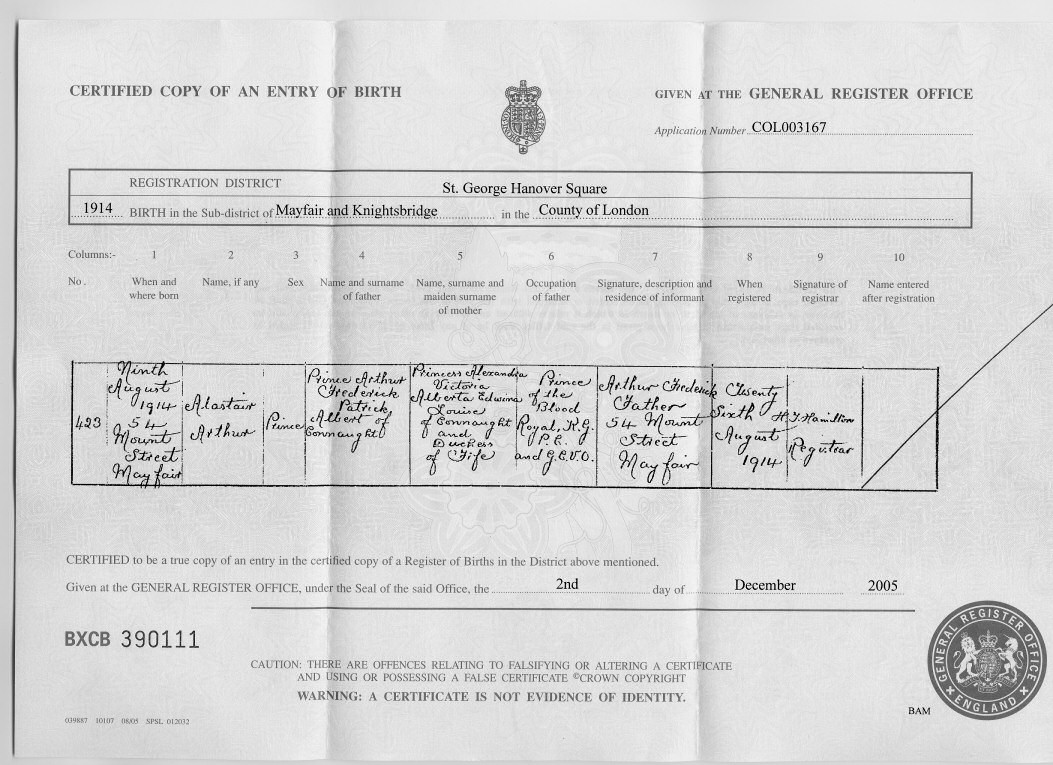
- Alastair Arthur of Connaught, born in 1914, the first
instance of
a great-grandchild of a sovereign in male line born in Britain who was
not more closely related to a sovereign (the 2nd duke of Gloucester and
his sister had an uncle king, the Cumberlands and the
Saxe-Coburg-Gothas were born abroad).
It appears that he was thought to be a prince, and in March 1917 George
V asked that
a warrant be prepared formally granting him the style of Highness, but
changed his mind in May, and the warrant was never issued, although
several publications gave him the style until about
1924. He happened
to be the son of the duchess of Fife mentioned above.
Both cases (the Cumberlands and Alastair of Connaught) are
discussed in more detail below.
1.3 Conclusion
The following conclusions can be drawn:
- until 1917, the title of Prince was purely customary (except for the
grant in 1905 to the daughters of the Princess Royal, and
in 1914 to
the children of the duke and duchess of Brunswick)
- sons of the sovereign were princes and RH from the 17th c.
(formalized in 1864 and 1917)
- daughters of the sovereign were princesses from the
Restoration,
RH from George I
- sons of the eldest son of the Sovereign were Prince and H
from
George I, RH from 1737
- daughters of the eldest son of the Sovereign were Princess
under
George I, Lady under George II, Princess thereafter; H from George I,
RH from 1737
- other grandsons of the sovereign (in male line) were Prince
from
George I, H from Charles II, RH after 1830 (formalized in 1864 and 1917)
- other granddaughters of the sovereign (in male line) were
Princess and H under George I and from George III,
RH after
1830 (formalized
in 1864 and 1917)
- under Victoria, a pattern developped to make British
children of
daughters of the sovereign "Prince" and "Highness" (grants ad
personam 1867, 1887, 1905; practice ended after 1917); they had been H
under James II
- great-grandchildren of the sovereign who were children of
the
eldest son of any Prince of Wales were "Prince/ss" and "Royal
Highness"
(formal grant in 1898; restricted to the eldest living son of the
eldest son of the, rather than any, Prince of Wales in 1917;
extended again to the
children of the eldest son of the Prince of Wales in 2012)
- great-grandchildren of the sovereign (in male line) were
Prince/ss
and H except in the previous case (preamble
of the Letters Patent of 1864; first instance
under George III; ended in 1917)
- more distant descendants of the sovereign (in male line)
were Prince/ss and H (preamble of the Letters Patent of
1864; ended in 1917)
1.4 The letters patent of 1864 and
1917
The letters patent of 1864
and 1917 are the two main general
dispositions concerning styles and titles in the royal family.
They are, however, of a different nature:
- the letters patent of 1864 have the effect of
- confirming, and making explicit, what was hitherto a
century-old custom, namely, giving the style of "Royal Highness" to the
children of a sovereign and to the children of sons of a sovereign.
- It said nothing about the title of prince, except to
implicitly confirm that the same people received it.
- It also said nothing, either positive or negative,
about
usage for other individuals. However, subsequent letters patent
(1867, 1886, 1905) refer in their preamble to the letters of 1864 as
"defining and limiting" the style of Royal Highness.
- the letters patent of 1917 have the effect of
- confirming the dispositions of the letters of 1864,
- restricting (although they are not cited in the preamble)
the dispositions of the letters of 1898 to the
eldest living son (since 2012 the children) of the eldest son of
the prince of Wales,
and
- denying the title of prince and the styles of royal
highness,
highness or serene highness to anyone else, except those already
granted by letters patent and remaining unrevoked
Thus, the letters of 1864 granted or confirmed certain styles for
certain people without explicitly confirming or denying them for the
rest, while
the letters of 1917 explicitly deny the styles to those who are not
explicitly entitled to them. The letters of 1917 are thus much
more complete and precise.
Since the letters of 1917 denied certain styles to certain people, what
happened to those who already had them at the time they were
passed? Many of these titles had been granted by royal warrant
rather than letters patent, but it is doubtful that the distinction is
meaningful here. The last holder of a British style of Highness
died in 2005.
Prince of what?
When we speak of the title of Prince, is there a territorial
designation attached to it? Not necessarily. In the letters
patent and warrants that define or grant the title, it is
described as a "titular dignity prefixed to their respective
Christian names", a formulation that does not allow for the addition of
any territorial designation when the title is properly used.
The only grant that makes any mention of a territorial designation
before 1957 is that of 1914
(for the children of the duke and duchess of Brunswick), which adds a
territorial designation ("of the United Kingdom of Great Britain and
Ireland") to an existing title of prince, whereas their father and
aunts had been declared "born prince/ss of Great Britain and Ireland"
before. It is clear, however, from the documents concerning this
warrant, that this designation was explanatory in nature, since the
warrant was issued in response to a question from the State Minister of
Brunswick. Moreover, the Home Office thought he was already a Prince
and "that properly his designation is "a Prince of the United Kingdom
of Great Britain and Ireland" (more fully "a Prince of the Royal Family
of etc" or "a Prince of the Blood Royal of etc", but these seem too long,
and the shorter designation has the sanction of precedent)." Thus, the
unusual phrase is not only explanatory, but merely a shorthand.
Actual practice shows little consistency in the matter. The
expression "prince of Great Britain" appears under the Hanoverians
(e.g., the styles of the prince of Wales in 1714, 1729, 1751) and that
of "Prince of the United Kingdom of Great Britain and Ireland" under
Victoria and George V (e.g., the styles of the prince of Wales in 1841
and 1911). Yet the 2nd duke of Albany is called "born prince of
Great Britain and Ireland" in the royal consent to his marriage.
Princess Frederica of Hanover is called "princess of Great
Britain and Ireland", while the members of the next generation of
Cumberlands (1900-13) are called "born prince(ss) of Great Britain and
Ireland". But Ernst August, in 1951, is called "prince of
Great Britain". Army lists of the 1910s and 1920s list Prince Henry W.F.A.
(son of the king, future duke of Gloucester) as "Prince of Great Britain".
The
letters patent of Nov. 30, 1917, which grant the
title of prince explicitly to children of a sovereign and children of
sons of a sovereign, specify no territorial designation.
The only formal grant posterior to the letters patent of 1917 (to the duke of Edinburgh in 1957)
specifies "of the United Kingdom of Great Britain and Northern
Ireland". This, however, is a rather unique instance of a
conferral on someone who was not directly in the line of succession
(although he was a descendant of Queen Victoria). Initially,
Elizabeth II had proposed to have him declared "Prince of the
Commonwealth", but the government opposed the idea. It was later
decided to make him a "Prince of the United Kingdom of Great Britain
and Northern
Ireland and her other Realms and Territories", but the last six words
were ultimately dropped. Nothing can be concluded from this single
grant about any putative territorial designation for the title of prince
as conferred by the general rules laid down in 1917.
2 Practice and Customs from 1660 to
1917
The Stuarts
The only interesting cases are
- the children of the duke of York, nephews and nieces of
Charles
II, before the accession of their father as James II; and
- the children of the Princess Anne of Denmark by her
husband
Prince George of Denmark,
all of whom died before her accession as Queen Anne on March 8, 1702.
Before 1688 they were
grandchildren of the king (in female line), after 1688 they were
nephews/nieces of the sovereign.
Information on their styles can be found in a couple sources:
- their "deposita",
i.e., the inscriptions placed on their coffins at burial in Westminster
Abbey (see more on
the deposita of the British royal family). (from John
Dart: Westmonasterium.
London, 1742. Vol. 2, p. 51). An asterisk below indicates that
Dart cites the burial but does not provide the text of the depositum.
- in the register of burials at
Westminster, (from Collectanea topographica et genealogica,
London, J.B. Nichols and Son, printers, 1834-43; vol. 7 and vol. 8)
- Garter's memorandum of the 1850s
or
early 1860s
The Children of the duke of York (James
II)
What follows is the list of the children of James as duke of York (from
1660 to 1682), with the corresponding entry in the register of burials
and the text of the depositum when applicable and available:
- Charles, duke of Cambridge, b. Oct 22/Nov 1, 1660, died May
5/15
1661
- May 6: Charles, Duke of Cambridge, son to the Duke
of
York
- Depositum Celsissimi Principis Caroli Ducis
Cantabrigiæ, filii primogeniti Jacobi Ducis Eboracensis: qui
natus 22 die Octobris 1660. Obiit in Aula Whitehall
quinto die Maii MDCLXI.
- Mary (later Queen Mary), b. Apr 30/May 9, 1662
- James, duke of Cambridge, b. Jul 12/22 1663, d. June 20/30,
1667
- June 26: The Duke of Cambridge, eldst son to the
Duke of
Yorke
- Depositum Illustrissimi Principis Jacobis Ducis
Cantabrigiæ, &c. filii secundo-geniti & Herædis
Potentissimi Principis Jacobi Ducis Eboraci, qui in Aula Regia
Richmondiæ vicesimo die Junii in Domino
obdormivit. Ætatis suæ Quarto; Annoq; Domini MDCLXVII.
- Anne (later Queen Anne), b. Feb 6/16, 1665
- Charles, duke of Kendall, b. Jul 4/14 1666, d. May 22/June
1, 1667
- May 30: the Duke of Kendall, 2d son to ye Duke of
York
- Depositum Illustrissimi Principis Carolis Ducis
Condaliæ [Dart: Candaliæ] &c. filii tertio geniti
Potentissimi Principis Jacobi Ducis Eboraci, qui in Aula Regia sancti
Jacobi dicta, vicesimo secundo die Maij in Domino
obdormivit, vix annum habens, Anno Domini MDCLXVII.
- Edgar, duke of Cambridge, b. Sep 14/24 1667, d. June 8/18,
1671
- June 12: Edgar, Duke of Cambridge
- Depositum Illustrissimi Principis Edgari Ducis
Cantabrigiæ &c. filii quarto geniti & Herædis
Potentissimi Principis Jacobi Ducis Eboraci, qui in Aula Regia
Richmondiæ, 8. die Junii in Domino
obdormivit, ætatis suæ quarto, Anno Dom. MDCLXXI.
- Henrietta b. Jan 13/23, d. Nov 15/25, 1669
- Nov. 9: The Lady Henrietta, d. to the D.k of York
- Depositum Illustrissimæ Dominæ
Henriettæ filiæ natu-tertiæ Potentissimi Principis
Jacobi Ducis Eboraci, quæ in Aula Regia sancti Jacobi dicta,
decimo
quinto die mensis Novembris in Domino obdormivit decem circiter mensium
ætatis, Anno Domini MDCLXIX.
- Catherine b. Feb. 9/19, d. Dec 5/15 1671
- Dec. 8: The Lady Kath. ye Dk of York's youngst
dau.r
- Depositum Illustrissimæ Dominæ
Catherinæ filiæ tertio-genitæ Potentissimi Principis
Jacobi Ducis Eboraci, quæ in Aula Regia sancti Jacobi dicta, in
Domino obdormivit, vix decem menses habens, quinto die Decembris, Anno
a Christo nato, MDCLXXI.
- Katherine Laura b. Jan 10, 1675, d. Oct 3/13 1675
- Oct. 5: Catherine Laura, a young child of ye Dk of
York's
- Depositum Illustrissimæ Dominæ
Katherinæ Lauræ ex secundis nuptiis filiæ
primo-genitæ Potentissimi Principis Jacobi Ducis Eboraci,
quæ in Aula Regia Sti. Jacobi dicta tertia die Octobris
obdormivit, vix novem menses habens, Anno Dom. MDCLXXV.
- Charles, duke of Cambridge, b. Nov 7/17, 1677, d. Dec
12/22, 1677
- Dec. 13: The Dk of Cambridge
- <*>
- Isabella, b. Aug 28/Sep 7, 1676, d. Mar 2/12 1680
- Mar. 4: The Lady Isabella, da. to the Duke of Yorke
- Depositum Illustrissimæ Dominæ
Isabellæ filiæ septimogenitæ Potentissimi Principis
Jacobi Ducis Eboraci, &c. & conjuge Maria D'Este quæ in
Aula Regia Sti. Jacobi dicta secundo die Martii sexcentessimo
octogessimo in Domino obdormivit, ætatis suæ anno currente
quinto, Anno Dom. MDCLXXX.
- Charlotta Maria, b. Aug 15/25, d. Oct 16/26, 1682
- Octob. 8: The Lady Charlotte Marie, dau.r to the
Dk of
Yorke
- <*>
- James Francis Edward b. June 10/20, 1688
- Louisa Maria Theresia, b. June 28, 1692
The children of Princess Anne (Queen Anne)
What follows is the same list for the children of Princess
Anne
(from 1684 to 1700)
- a daughter, stillborn May 12/22, 1684
- <>
- Hic jacet Filia primogenita Illustrissimi Georgii
&
Annæ,
Daniæ principis, illustrissimi Jacobi Eboraci Ducis neptis, nata
mortua die Maij 12. MDCLXXXIIII
- Lady Mary, b. June 2/12, 1685, died Feb. 8/18, 1687
- 10 Feb 1686-7: the Lady Mary, eldest dau[]r to
their
Royall Highnesses Prince
George and the Princess Ann of Denmark.
- Depositum Illustrissimæ Dominæ
Mariæ,
Filiæ natu
secundæ Illustrissimi Principis Georgii Daniæ &
Norvegiæ
principis hæreditarij &c. Ex illustrissima Anna conjuge
Charissima Filia secunda serenissimi Principis, Jacobi Magnæ
Britanniæ Regis &c. Nata Junij 2. MDCLXXXV Obiit
Feb. 8 Ætatis
suæ secundo, Annoq: Dom. MDCLXXXVI
- Lady Anne Sophie, b. May 12/22 1686, died Feb. 2/12, 1687
- 4 Feb 1686-7: the Lady Anne Sophie, youngest
dau[]r to
their Royall Highnesses
Prince George and the Princess Ann of Denmark.
- Anna Sophia, filia natu tertia secundæ
Illustrissimi Principis Georgii Daniæ & Norvegiæ
principis hæreditarij &c. Ex illustrissima Anna conjuge
Charissima Filia secunda serenissimi Principis, Jacobi Magnæ
Britanniæ Regis &c. Nata Maij 12. obiit die Purificationis B.
M. Virginis, Anno Dom. MDCLXXXVI Ætatis Primo.
- a male foetus, Oct 22/Nov 1, 1687
- 22 Oct 1687: The Princess Ann's child, a
chrissome,
bu[]d in ye vault
- Depositum Foetus Masculi Abortivi, Illustrissimi
Illustrissimi Principis Georgii Daniæ & Norvegiæ
principis hæreditarij &c. Ex illustrissima Anna conjuge
Charissima Filia secunda serenissimi Principis, Jacobi Magnæ
Britanniæ Reg. &c. Oct. 22 An. Dom. MDCLXXXVII.
- William, duke of Gloucester, died July 30/Aug 10, 1700
- Friday 9 Aug 1700: His Royall Highness Will[iam]
Duke of
Gloucest[e]r, the only
son of their Royall Highnesses Prince George and the Princess Ann of
Denmark,
was bur[ie]d in the royall vault on the south side of H[enry] 7
Ch[apel].
- Depositum Illustrissimi Principis Gulielmi Ducis
Gloucestriæ
Nobilissimi Ordinis Aureæ Periscelidis Equitis Filii unici
Celcissimæ Annæ, per Inclytissimum Principem Georgium
Daniæ hæreditarum: obiit in Castro Regali apud Windsor, xxx
Die Julij MDCC Anno Ætatis XII ineunte.
- Lady Mary, born October 1690, died soon after, buried Oct 14
- 14 Oct 1690: The Lady Mary, da. of their Royall
Highnesses Prince George and the
Princess Ann of Denmark.
- George, born Apr 17/27, 1692, died the same day after
baptism
- 18 Apr 1692: L[or]d George, s[on] to Prince and
Princess
of Denmark.
- <*>
- stillborn daughter March 23/Apr 2, 1693
- 24 Mar 1692-3: A still born child of Prince
George's
- <*>
William, duke of Gloucester
(1689-1700)
William, duke of Gloucester, was the only son of Princess Anne who
survived beyond infancy. He was born on July 24, 1689 and
baptized on July 27, at which time he was declared Duke of
Gloucester (letters patent were never issued). After the death of
Queen Mary in 1694, Princess Anne became (under the terms of the
Bill of Rights of 1689) heiress apparent to king William III, and the
duke Gloucester was "heir apparent to the heir apparent", the
equivalent to the eldest son of a prince of Wales under normal
circumstances. But, strictly speaking, he was only the grandson
in female line of a
sovereign, residing in Britain, a position for which there was no real
precedent. He was thus second in line to the throne, but also
(since William was unlikely to remarry and have children) the last: his
death in 1700 prompted Parliament to pass the Act of Settlement in 1701
to extend the order of succession beyond Anne.
We are better informed on his styles since he lived long enough to
receive honors (Francis Sandford:
A
Genealogical History ...
London, 1708, p. 861-64):
- He was installed as Knight of the Garter on July
24,
1696, following dispensation granted by warrant of April 8, 1696; the
same warrant directed that he should be entered in the registers of the
Order by the name of William, son to the Princess Anne, by Prince
George of Denmark, and gave him as mark of difference a label of three
points argent bearing the red cross of England, and an
inescutcheon with the arms of Denmark.
- The titles engraved
on his plate in the knights' stalls at Windsor were "Du tres haut, Tres
Puissant, & Tres Illustre
Prince GUILLAUME, Fils de la Princesse ANNE, par le Prince George de
Danemark, Installe au Chateau de Windesore le xxive jour de Juillet,
l'an MDCXCVI."
- The styles proclaimed at his burial by Garter King
of Arms were: "the most Illustrious Prince, William, Duke of
Glocester, Knight of the Most Noble Order of the Garter, Only Son of
the High and Mighty Princess Anne, by His Royal Highness Prince George
of Denmark."
As far as "Highness" vs. "Royal Highness" is concerned, the texts of
the time show no consistent pattern. It is interesting to note
that Sandford's continuator, Samuel
Stebbing, who was Somerset Herald and presumably paid attention to such
matters, systematically calls the duke of
Gloucester "His Highness".
Garter's
memorandum also states that
the public announcements on his illness and death, the Earl Marshal's
orders for the funeral, and the ceremonial all style him
Highness.
George I
When George I acceded in 1714, he had one son, married with children,
and one daughter, married since 1706 to
the king of Prussia. He also
had two brothers, Maximilian Wilhelm (1666-1726), who lived in Austria,
and Ernst August
(1674-1728) who was created duke of York on July 14, 1716 (n.s.).
The duke of York was styled Highness.
George I's only son (the future George II) was created prince of
Wales on
Sep.
27, 1714 (o.s.). This prince of Wales had one son and three daughters
when
George I succeeded, and this was the first instance of a reigning
sovereign with grandchildren in the male line since Edward III.
However, these grandchildren were all children of a sovereign's eldest
son, so offer no precedebnts for other granbdchildren of a sovereign.
George I's grandchildren were:
- Frederick Lewis (Jan 31 1707 n.s. -Mar
20 1751 n.s.), cr. duke of Edinburgh in 1726
- George William (Nov 13 1717 n.s. -
Feb 17 1718 n.s.)
- William
Augustus of Wales (Apr 26 1721n.s. - Oct
31 1765), cr. duke of Cumberland in 1726, who never married;
- Anne (Feb 11 1709-Jan 12 1759),
created Princess Royal on Aug 30, 1727,
who married the prince of Orange in 1734;
- Amelia (Jul 10 1711- Oct 31
1786);
- Caroline
Elizabeth (1713-Dec 28 1757);
- Mary (Mar 5 1723 n.s. -
Jan 14 1772) who married the future landgrave of
Hesse-Cassel in 1740;
- Louisa (Dec 18 1724 n.s. - Dec 19 1751
n.s.) who married the future king
of Denmark in 1743.
During the reign of George I, it appears that royal grandchildren,
even though children of the Prince of Wales, were styled princes and
princesses but received the attribute of "Highness" rather than "Royal
Highness". See for example the gazetting of the creation of
his two grandsons as dukes on July 15/26, 1726 (London Gazette
6494):
"His Majesty has been pleased to create
his Highness Prince
Frederick, a Baron, Viscount, Earl, Marquess, and Duke of the Kingdom
of Great Britain, by the Names Stiles and Titles of Baron of Snaudon in
the County of Caernarvon, Viscount of Lanceston in the County of
Cornwall, Earl of Eltham in the County of Kent, Marquess of the Isle of
Wight and Duke of Edinburgh. His Majesty has been pleased to create his
Highness Prince William, a Baron, Viscount, Earl, Marquess, and Duke of
the Kingdom of Great Britain, by the Names Stiles and Titles of Baron
of the Isle of Alderney, Viscount of Trematon in the County of
Cornwall, Earl of Kinnington in the county of Surrey, Marquess of
Berkhamstead in the County of Hertford, and Duke of Cumberland."
Garter's memorandum states that George
William was buried with the
style of Highness.
A statement of the current practice appears in Chamberlayne's Magnae Britanniae Notitia
(e.g., 1726 edition, p. 61):
"The daughters of England are stiled
Princesses, the Eldest of which to violate unmarried is High-Treason at
this Day. To all the King's children belong the Title of Royal Highness
[...] All the King's Sons, Grandsons, Brothers, Uncles, and
Nephews of the King, are by Stat. 3 Hen VIII to precede other in
England. it is true, the Word Grandson is not there in terminis,
but it is understood (as Sir Edward Coke holds) by Nephew, which in
Latin being Nepos, signifies also, and chiefly, a Grandson."
An example of the styles of the Royal Family can be found in An Exact List of the Lords Spiritual and
Temporal, 1719. The list of members of the House of Lords
begins as follows :
His Royal Highness George
Augustus (Prince of Great Britain, Electoral
Prince of Brunswick-Lunenburgh, Duke of Cornwall and Rothesaye, Duke
and Marquis of Cambridge, Earl of Milford-Haven, and of Carreck,
Viscount Northallerton, Baron of Tewkesbury, and of Renfrew, Lord of
the Isles, and Steward of Scotland, and Knight of the Most Noble Order
of the Garter,) Prince of Wales, and Earl of Chester. P.C.
His Royal Highness Earnest Augustus (Prince of Brunswick-Lunenburgh,
Bishop of Osnabrugh), Duke of York and Albany, and Earl of Ulster.
His Highness Prince Frederick (eldest son of His Royal Highness the
Prince of Wales) Duke of Gloucester.
Other examples of contemporary usage (although less
authoritative):
Basil Kennett's Romae antiquae
notitia (London, 1726) is dedicated to "His Highness the duke of
Gloucester", Saint John Fisher's Practical
discourse upon private prayer (London, 1719) is dedicated to
"His Highness Princess Anne." On the other hand, the Historical Register (1717, p. 90;
1727, p. 55) uses the phrase "His Royal Highness Prince Frederick", but
this seems to be an exception.
George II
When George II acceded in 1727 he had two sons and five daughters,
none married, but in the course of his reign he would see nine grandchildren, all
born to his son Frederick Lewis, cr. prince of Wales in 1729 (his other son, the duke of Cumberland,
never married):
- George William Frederick (June 4 1738 n.s.
- Jan 29 1820), duke of Edinburgh in 1751, cr. P of Wales 1751, later George III
- Edward Augustus (Mar 25 1739
n.s.- Sep 17 1767), Duke of York and Albany in 1760
- William Henry (Nov
25 1743 n.s.- Aug 25 1805), Duke of Gloucester and Edinburgh in 1764
- Henry Frederick (Nov
7 1745 n.s.- Sep 18 1790), Duke of Cumberland and Strathearn in 1766
- Frederick William (May 24 1750 n.s. -
Dec 29 1765)
- Augusta (Dec 8 1737 n.s. - Mar
23 1813), married the hereditary prince (later duke)
of Brunswick in 1764
- one of her daughters, Caroline, married in 1795 the
Prince of
Wales
- Elizabeth Caroline (Jan 10 1741 n.s. -
Sep 4 1759)
- Louisa Anne (Mar 19 1749-May 13 1768)
- Caroline Matilda (Jul 22 1751n.s. -
May 10 1775), married the king of Denmark in
1766
Of these, the only one to have any issue was the duke of
Gloucester,
who had William Frederick, later 2nd duke of Gloucester, and Sophia
Mathilda.
As the first great-grandchildren of a sovereign in male line they will
be examined in
detail below.
Once again, from 1738 there were grandchildren of the
sovereign in
male line, but they were all children of the Prince of Wales.
However, in contrast with the preceding reign, it appears that these
grandchildren were styled royal highnesses, although the daughters were
not Princesses. This was a decision of the Prince of Wales,
according to Garter's memorandum.
For
further evidence,
see the announcement of the creation of Edward Augustus as duke of York
and
Albany:
"Whitehall, April 1. The King has been
pleased to grant unto
His Majesty's dearly beloved Grandson Prince Edward Augustus, and to
the Heirs Male of his Royal Highness, the Dignities of Duke of the
Kingdom of Great Britain, and of Earl of the Kingdom of Ireland, by the
Names, Stiles and Titles of Duke of York and of Albany in the said
Kingdom of Great Britain, and of Earl of Ulster in the said Kingdom of
Ireland" (London Gazette
9981, March 29, 1760).
See likewise the entry in the register of
burials at St. Peter's, Westminster (Harleian Society Publications,
vol. 10, p. 395):
"Her Royal Highness Princess Elizabeth
Caroline, 2d
daughter of his late Royal Highness Frederick Prince of Wales".
George III
George III acceded in 1760, unmarried. His brothers were sons
of an
eldest son of king.
He married in 1761 and had a number of children, including the
following sons:
- George Augustus Frederick
(1762-1830), prince of Wales, later George IV
- Charlotte (1796-1817)
~ 1816 Prince Leopold of Saxe-Coburg and Gotha
- Frederick Augustus (1763-1827), duke of York and Albany in 1784, married
without issue
- William Henry (1765-1837), duke of Clarence and St. Andrews in 1789,
later William IV
- two daughters who died in infancy
- Edward Augustus (1767-1820), duke of Kent and Strathearn in 1799
- Ernest Augustus (1771-1851), duke of Cumberland and Teviotdale in 1799, later
Ernst
August I of Hanover
- one son
- further issue (see below)
- Augustus Frederick (1773-1843), duke of Sussex in 1801
- Adolphus Frederick (1774-1850), duke of Cambridge in 1801
- George, 2nd duke of Cambridge (1819-1904)
- Augusta (1822-1916)
~ 1843 grand-duke of Mecklenburg-Strelitz
- Mary Adelaide (1833-1897)
~ 1866 Francis, duke of Teck [H 1887]
George III had many sons, but few grandchildren in male line:
two
grandsons and three granddaughters. Of his sons, the duke of York
married in 1791 but had no issue, the
prince of Wales
married in 1795 and had only one daughter, princess Charlotte; the duke
of Cumberland married in 1815 and his only son Georg was born in Berlin
in May 1819, seven months
before the death of George III. Sussex married in
contravention to the
Royal
Marriages Act. The dukes of Clarence, Kent, and Cambridge all married
in 1818, in a rush to produce heirs after the untimely death of
Charlotte
of Wales. Kent had one daughter who became Queen Victoria.
Clarence had two
daughters who
died in infancy. Only the duke of Cambridge produced a son, born
in Hanover in
March 1819,
a few months before the death of George III. Cambridge also
had two daughters.
George III's grandchildren, even after his death (whereby they
became nephews and nieces of the sovereign) were styled Highness:
examples include the announcement of the death of Princess Elizabeth,
daughter of the duke of Clarence, in 1821; the act in 1825 providing an
annual sum for the support of Prince George Frederic of Cumberland, the
act of the same year providing a sum for the support of Princess
Alexandrina Victoria of Kent (later Queen Victoria).
After 1830, however, the grandchildren of George III were
styled
Royal
Highness. This began at the funeral of George IV, where Prince
George of Cambridge was so styled by command of the new king.
Likewise, the Act of the same year providing for a regency in case
Victoria should accede as a minor styles her Royal Highness. At
the election of Princes George of Cambridge and George Frederic of
Cumberland to the Order of the Garter in 1835, the king again directed
that they be so styled.
Queen Victoria continued this custom.
The Act of Parliament
settling an annuity for Augusta of Cambridge on her marriage to
the grand-duke of Mecklenburg-Strelitz in 1843 (6 & 7 Vict. c 25)
styles her a
Princess and a Royal
Highness. Her sister, Princess Mary Adelaide of Cambridge, was
since 1843 the only unmarried British princess other
than Queen Victoria's daughters. In a message to the House of
Commons in 1850 asking for the settlement of an annuity for her, she is
styled by the Queen Princess and Royal Highness. Both she and her brother
the duke of Cambridge are styled Prince and Royal Highness in the
Act (13 & 14 Vic c. 77). Princess Mary of Cambridge was finally
married in 1866
to the 1st duke of Teck, who was created a Highness in 1887 and took up
residence in Britain. Their eldest son the 2nd duke of Teck was
created a Highness in 1911.
It was Queen Victoria's desire to
formally extend the style to all grandchildren of the sovereign in male
line that led to the Letters Patent of 1864 (see C. B. Phipps' letter
to the Lord Chancellor of Jan 21, 1864, in National Archives, HO
45/8933/2: "The Queen is quite decided as to the
propriety of extending the title of Royal Highness to all
grandchildren, being the children of sons of a Sovereign.")
The next generation in male line from George III is even sparser, since the second duke
of
Cambridge,
grandson of George III, married in contravention to the Royal Marriages
Act and died in 1904. George III's only other grandson in male
line, the duke of Cumberland, had male issue that
continues to this day. As it is the second
instance of great-grandchildren of a sovereign in male line (after
the 2nd duke of Gloucester, born 1776) it will be
examined below.
Of the daughters of George III:
- Charlotte Augusta Matilda (1766-1828), Princess Royal,
married in
1797 the hereditary prince (later duke, still later king) of Wurttemberg
- Augusta Sophia (1768-1840) never married
- Elizabeth (1770-1840) married in 1818 the landgrave of
Hesse-Homburg
- Mary (1776-1857) married in 1816 her cousin the 2nd duke of
Gloucester, who was created HRH
on that occasion; they had no issue
- Sophia (1777-1848) never married
- Amelia (1783-1810) never married
so there were no grandchildren of George III in female line who resided
in the UK.
The 2nd Duke of Gloucester
The only grandson of George I in
male line to have any issue (aside from George III) was William Henry
(Nov 14/25, 1743 - Aug 25, 1805). He was created duke of
Gloucester on Nov. 17 or 19,
1764. About
that time, he fell in love with Maria Waldegrave (1736-1807), widow of
the 2nd earl Waldegrave. She was the daughter of Sir Edward
Walpole (a younger son of the Prime Minister) and Dorothy Clement or
Clements, who
were not married. She was thus not only of relatively modest
origin (certainly not royal), but also a bastard child. Her
family connections nevertheless let her enter society and marry rather
successfully the earl Waldegrave, who had been lord of the bedchamber
of George II and governor of the future George III. He died of
smallpox in 1763 and left her widowed with three daughters.
Prince William Henry married her secretly on Sept. 6, 1766. But
he did not reveal the marriage; instead, she took the role of official
mistress, and even received a pension from George III on the Irish
revenues. But, after the duke of Cumberland's marriage became
public in 1771, Gloucester revealed his own to his brother in
1772. George III ordered an inquiry into the validity of the
marriage, which was certified as valid a few days before the birth of
their first child, Sophia Mathilda, on May 29, 1773. Two other children
followed: Caroline Augusta Maria (June 24 1774- March 1775) and William
Frederick on
Jan 15, 1776 in Rome. By 1777 George III and his brother were
reconciled and
legislation to provide for the family was passed in 1778 (18 Geo III c.
31). In the act, the two surviving children of the duke of
Gloucester are called "his Highness Prince William Frederick, the son
of his said Royal Highness the Duke of Gloucester" and his sister "her
Highness Princess Sophia Matilda, the daughter of his said Royal
Highness the Duke of Gloucester".
The marriages of Cumberland and Gloucester prompted the passage of the
Royal Marriages Act in 1776, which for the first time placed
restrictions on princes' ability to marry without consent. But,
as the marriages had taken place before and were technically valid in
English law, there was no way to deny the issue their status in the
British royal family. Matters were different in Hanover, where
rules about unequal marriages certainly precluded the marriage of a
Hanoverian dynast with the illegitimate daughter of a member of the
gentry from being admitted as valid for succession purposes.
Gloucester's marriage was unequal, and his issue was in principle
excluded from the dynasty. In fact, the duke of Gloucesters's two
children were not
listed in the genealogical listing of the electoral house of Hanover in
the Königlicher
Groß-Britannischer und Kurfürstlicher
Braunschweig-Lüneburgscher Staats-Kalender, although he
was. Hermann Schulze (Hausgesetze,
vol. 1, p. 408) states that William Frederick was treated in Germany as
a British
prince but not as an agnate of the house of Brunswick, and cites Carl
Friedrich Häberlin: Staats-Archiv,
vol. 1 [1796], p. 91 and Karl Friedrich Eichhorn: Über die Ehe des Herzogs von Sussex p.
170. He also notes the significant fact that the William
Frederick, as 2nd duke of Gloucester,
was not invited to sign the family compact of the house of
Brunswick-Luneburg in 1831 when all other agnates residing in Britain
did so. Since family compacts needed the consent of all agnates,
this is clear evidence that William Frederick was not considered an
agnate of the house of Brunswick-Luneburg.
In Britain, the children of the 1st duke of Gloucester were
consistently given the rank of prince and the style of Highness:
- Annual Register
1789, p.
250;
- London Gazette13685,
Jul.
15, 1794, p. 728, account of his election as Knight of the Garter:
"Prince William Frederick (now out of the Kingdom), son of his Royal
Highness the Duke of Gloucester";
- Annual Register
1794, p. 323, Chron. p. 68;
- Gentleman's Magazine
1794 i. 375;
- London Gazette13755
Feb.
24, 1795, p. 187: "His Highness Prince William, of the 115th Foot, to
be major-general in the army").
- Court and City Register 1795,
p. 144: "His Highness Prince William of Gloucester";
- Annual Register 1799
chron. appendix p. 145;
- Annual Register 1806
Chron. p. 173;
- Journal of the House of
Lords
(1806): account of his reception when he succeeded his father: "His
Highness the Duke of Gloucester"
A few exceptions: the Annual Register
on his admission to the degree of MA at Cambridge in 1790 (p. 210):
"his royal highness prince William Frederick".
A brief account of the 2nd duke of Gloucester's unremarkable career:
MA Canta 1790, LLD 1796, chancellor of the university Mar 26, 1811,
installed June 29. Colonel in the 1st regt Foot Guards 11 Mar
1789. Full colonel Feb 8, 1794, command of the 115th Foot May 3,
major-general Feb 16, 1795 [recte Feb 27], colonel of the 6th ret of
foot 8 Nov. Lt General Nov 13, 1799. Colonel of the 3d regt foot guards
May 31, 1806, general April 25, 1808; field marshal May 1816.
Elected KG July 16, 1794, received insigns July 27, installed May 29,
1801. PC Feb 1, 1806. GCB Apr 12, 1815. GCH Aug 12, 1815. Ranger
of Bagshot Walk 1798, governor Portsmouth 1827.
William Frederick (1776-1834), the 2nd duke of Gloucester, as only male
agnate in Britain aside from the brothers of George III, was long kept
in reserve while Princess Charlotte, only daughter of the Prince Regent
and heir presumptive, decided whom to marry. Her marriage to
prince Leopold of Saxe-Coburg and Gotha allowed the duke to marry his
long-time love, George III's daughter Mary (1776-1857), on July 22,
1816. He and his sister received the style of
Royal Highness by warrant of July 22, 1816.
Queen Victoria
Queen Victoria was the first British sovereign to see the
birth of a
great-grandchild.
- Albert Edward, Prince of Wales (1841-1910) later Edward VII
~ Alexandra of Denmark
- Albert Victor (1864-92) duke of Clarence and Avondale in 1890
- George (1864-1936), duke of York in 1892, Prince of Wales in 1901,
later George V
~ Mary of Teck
- Edward of York (1894-1972), Prince of Wales 1910,
later Edward VIII (1936)
- Albert of York (1895-1932), duke of York 1920, later George VI
- Henry of York (1900-1972), duke of Gloucester 1928
- George of York (1902-42), duke of Kent 1934
- John of Wales (1905-19)
- Mary of York (1895-1965), Princess Royal 1932,
viscountess Lascelles 1922, countess of Harewood 1929
- Louise of Wales (1867-1931), duchess of Fife 1889,
Princess Royal 1905
~ 1889 Alexander Duff, cr duke of Fife 1889 (1849-1912)
- Alexandra (1891-1959), [H 1905] duchess of Fife 1912
~ 1913 Arthur, Prince of Connaught
- Maud (1893-1945) [H 1905]
- Victoria of Wales (1868-1935)
- Maud of Wales (1869-1938), Princess Carl of Denmark 1895, queen of Norway 1905
- Alfred (1844-1900), duke of Edinburgh 1866, reigning duke of Saxe-Coburg-Gotha 1893
- Alfred (1874-99)
- Marie
- Victoria Melita
- Alexandra
- Beatrice
- Arthur (1850-1942), duke of Connaught and Strathearn 1874
- Arthur (1883-1938)
- Alastair Arthur (1914-43), 2nd duke of Connaught
- Margaret (1882-1920), Crown Princess of Sweden 1905
- Patricia (1886-1974), Lady Patricia Ramsay 1919
~ 1919 Sir Alexander Ramsay
- Alexander Ramsay (1919-2000)
- Leopold (1853-84), duke of Albany 1881
- Charles Edward (1884-1954), 2nd duke of Albany, reigning duke of Saxe-Coburg-Gotha 1900-1918
- Johann Leopold (1906-72)
- Hubertus (1909-43)
- Friedrich Josias (1918-98)
- Sibylla (1917-72)
- Caroline Mathilde (1912-83)
- Alice (1883-1981), Princess Alexander of Teck 1904, countess
of Athlone 1917
- Victoria (1840-1901), Princess Royal, Crown Princess of
Prussia
1858, Crown Princess of Germany 1871, Empress 1888, "Empress Frederick"
1888
- Alice (1843-78), princess of Hesse 1862, grand-duchess of Hesse 1877
~ 1862 Prince Louis of Hesse [RH 1862]
- Helena (1846-1923), Princess Christian of
Schleswig-Holstein
1866, Princess Christian (?) 1917
~ 1866 Prince Christian of Schleswig-Holstein [RH 1866]
- Christian Victor (1867-1900) [H 1867]
- Albert (1869-1931) [H 1867]
- Helena Victoria (1870-1948) [H 1867]
- Louise Marie (1872-1956) [H 1867]
- Louise (1848-1939), marchioness of Lorne 1871, duchess of
Argyll
1900
~ 1871 John, duke of Argyll (1845-1914)
- Beatrice (1857-1944), Princess Henry of Battenberg 1885
~ 1885 Prince Henry of Battenberg [RH 1885]
- Alexander (1886-1960), [H 1886] marquess of Carisbrooke 1917
- Leopold (1889-1922) [H 1886]
- Maurice (1891-1914) [H 1886]
- Victoria Eugénie Julia Ena [H 1886,
RH 1906]
The great-grandchildren of Queen Victoria in male line were
- the
children of the duke of York (born between 1894 and 1905),
- Alastair
Arthur, grandson of the 1st duke of Connaught (b. 1914),
and
- the children of Karl Eduard, reigning duke of
Saxe-Coburg-Gotha
(born between 1906 and 1918).
The letters patent of 1864
To be completed.
See the text of the letters patent.
The children of the duke of York between
1894
and 1898
The
Letters Patent of May 28, 1898 granted the style of Royal Highness
to "the children of the
eldest son of any Prince of Wales ... in addition to
such titular dignity of Prince or Princess ... as they may otherwise
possess". The letters themselves did not grant the title of
Prince (in fact, it explicitly doesn't do so by the use of the word
"otherwise"). So the title of prince which these children
undoubtedly had (Burke's Peerage
for 1895
styles the only child of the duke of York "Prince") is customary as all
others at the time.
The grant was made to "the children of the eldest son of any Prince of
Wales". This was taken to apply to the children of the duke of
York, second-born but eldest living son of the then Prince of Wales
(future Edward VII). In 1901, these children became children of a
son of the sovereign, and their style was now based on the letters
patent of 1864. The letters patent were amended by those of Nov
30, 1917 (although they were not cited in their preamble), since the
style of Royal Highness was now reserved to, among others, "the eldest living son of the eldest son of the Prince of
Wales". There are two differences: "the eldest living son", not
"the children", and "the Prince of Wales" (i.e. the prince of Wales at
any point in time), not "any Prince of Wales". Also, by
specifying "eldest living son", the letters imply that "eldest son"
means first-born. The letters patent of 1917 work differently
from those of 1898: (1) Suppose a
sovereign A whose eldest son B is Prince of
Wales. He has two sons C and D. C dies, leaving no issue.
D's eldest son would not be HRH, being son of the eldest-living son but
not eldest son of the Prince of Wales. This was in fact the
situation between 1894 and 1901. (2)
Suppose that B dies, leaving C and D. C is created Prince of
Wales, then
has a son E: E (greatgrandchild of the sovereign) would not be HRH,
being eldest son of the eldest son of "a" (late) Prince of Wales but
not of "the" prince of Wales. This changes were recognized
at the time the letters of 1917 were drafted, but as no one found a
concise way to encompass the various possible situations, it was
thought that such cases could be dealt with in an ad-hoc fashion.
It is interesting to note that an earlier draft of the
letters
patent contained the additional clause: "and that the
title of "Highness" shall be held and enjoyed by the other great
grandchildren of the sovereign". This explicit grant of the style
of Highness was dropped, under circumstances I do not know.
In anticipation of the birth of the Duke and Duchess of Cambridge's first
child, the letters patent of 31 December 2012 (gazetted 8 January 2013)
granted to the children (not just the eldest living son) of the eldest son of
the Prince of Wales the style of Royal Higness and the titular
dignity of Prince. This represents a partial return to the grant of 1898
(the difference being "the Prince of Wales" as opposed to "any Prince of Wales"
in the 1898 grant).
The dukes of Cumberland
The second instance of a great-grandson of a sovereign in male
line
came with the
dukes of Cumberland. They were even more remote from the
sovereign than the Gloucesters, since the 2nd duke of Gloucester was a
great-grandson of George II but also a nephew of George III.
Here is the line of the dukes of Cumberland to the 5th generation in
male line from George III:
- George III
- Ernst August I (1771-1851), duke of Cumberland, king of
Hanover
1837
- Georg V (1819-78) king of Hanover 1851-66, 2nd duke of
Cumberland
- Ernst August (1845-1923), 3d duke of Cumberland
1878-1919
~ 1878 Thyra of Denmark
- Marie Louise (1879-1948)
~ 1900 Maximilian prince of Baden
- Georg Wilhelm (1880-1912)
- Alexandra (1882-1963)
~ 1904 Friedrich Franz grand-duke
of Mecklenburg-Schwerin
- Olga (1884-1958)
- Christian Friedrich (1885-1901)
- Ernst August (1887-1953), duke of Brunswick 1913-18
~ 1913 Viktoria Luise of Prussia
- Ernst August (1914-87)
~ 1951
further issue
- Georg Wilhelm (1915-2005)
further issue
- Friederike Luise (1917-81)
~ 1937 king Paul of the Hellenes
- Christian (1919-81)
further issue
- Welf Heinrich (1923-97)
- Frederica (1848-1926)
~1880 Alfons von Pawel Ra(m)mingen
- Marie Ernestine (1849-1904)
George III's son Ernest Augustus, duke of Cumberland
(1771-1851)
succeeded William IV as king of Hanover in 1837. His son Georg V,
who was born in Great Britain and blinded in an accident in 1833,
succeeded him in 1851 but was dispossessed during the war of 1866 by
Prussia. He moved to Gmunden, in Austria, and always refused to
accept the annexation of his kingdom by Prussia. He died in Paris
on June 12,1878, and was buried on June 23 in St. George's Chapel,
Windsor. Interestingly, the Court Circular styles him "His late
Majesty King George of
Hanover, his Royal Highness the duke of Cumberland, K.G., First Cousin
of Her Majesty the Queen, General in her Majesty's Army", thus allowing
him a (British) style of Royal Highness distinct from his (Hanoverian)
style of Majesty.
George V's son Ernst August succeeded him at the head of the
house
of
Hanover.
At the time [July 11 according to Allemagne
Dynastique 3:185, July 10
according to other sources], he sent a
letter to the the king of Prussia
(translation from the Times,
Feb 3, 1879, p. 3D):
"Most illustrious, most potent
Prince,
dearest Brother and Cousin:
With a deeply-troubled heart I
fulfil the
sad duty of announcing to you that it has pleased God in His
unsearchable counsels to summon away from this life my much-loved
father His Majesty King George V., King of Hanover, Prince Royal of
Great Britain and Ireland, Duke of Cumberland, Duke of Brunswick and
Luneburg, etc., who died at Paris on the 12th of June this year, after
long sufferings. "In consequence of this stroke of death ,
involving great tribulation to me and my House, all rights,
prerogatives, and titles which appertained to the King, my father,
above all, and more particularly, with respect to the kingdom of
Hanover have now passed to me in virtue of the law in my House
regulating succession to the throne. All these rights, prerogatives,
and titles do I maintain in their fulness and entirety. As,
however, the exercise of the same with regard to the kingdom of Hanover
is impeded by restrictions which, of course, are not legally binding on
me, I have resolved, pending the duration of these obstacles, to bear
the title of 'Duke of Cumberland, Duke of Brunswick and Luneburg' with
the prefix 'Royal Highness.'
While, moreover, making this
communication I do not deem it necessary to intimate that the full and
independent rights of me and my House can inno wise be abolished or
restricted by the temporary non-use of the titles and dignities
denoting the same.
I remain your Majesty's
well-wisher,
brother, and cousin.
Ernst
August
To His Majesty the King of Prussia
Gmund, July 1878"
This assertion of his rights (and explicit refusal to recognize the
German Empire of 1871) precluded any settlement of the remaining
Hanover issues, but also would block him from succeeding to the duchy
of Brunswick, to which he was the heir presumptive. The
declaration also meant that the family, for the time being, was not
using any title related to the former kingdom of Hanover (in
particular, that of prince or princess of Hanover); the family resumed
the use of these titles on Aug 29, 1931 (Allemagne Dynastique 3:199).
The duke of Cumberland was made a knight of the Garter on June 24, 1878
(dispensation on July 20, 1878): in the London Gazette
announcement he is styled "His Royal Highness Ernest Augustus William
Adolphus George Frederick of Hanover, duke of Cumberland and
Teviotdale" At that point, a debate arose over his status in
Britain. Acccording to a memo by Garter in 1917 (LCO 2/7300), "the late Sir Albert Woods,
Garter, wrote a
carefully considered memorandum for the Queen in which he gave
his opinion that "the Princely title ceases with the
grandchildren of the Sovereign and does not extend to more remote
relationship". He stated however that no precedent
could be quoted and that it might be considered a moot point
which the Queen's Prerogative alone could decide." However, an
opinion of the Lord Chancellor of July 1878 (HO 144/44/86252) states clearly that
"in England the word [Prince] has
become by custom and the pleasure of the
Sovereign, the appropriate title of those who are of the Blood Royal,
the sons, grandsons and nephews of the Sovereign, and altrhough
occasions have not arisen in modern times for its application to
remoter issue there is not in my opinion any limit among those in
Succession to the Throne within which the use of the style of Prince is
to be confined, until some such limit is imposed by the Will of the
Sovereign as the Fountain of all Honour."
Queen Victoria, clearly satisfied by this opinion, had a copy sent to
Garter "to be duly
recorded so as to prevent any further controversy on this subject in
the future"; clearly, in 1917 Garter was not aware of the opinion.
In the royal consent given to his
marriage on Sept. 27, 1878, he is styled "Our Dear Cousin His Royal
Highness The Prince Ernest Augustus
William Adolphus George Frederick Duke of Cumberland and Teviotdale,
Earl of Armagh, Knight of Our Most Noble Order of the Garter" (PRO HO
124/18). On
Dec. 21 of the same year he married Thyra,
daughter of king Christian IX of Denmark and sister of the princess of
Wales, the result of a negotiation that had begun while Georg V was
still alive.
Whatever the doubts about his status as prince, they were
resolved
two years later, when his sister Frederica married at Windsor on Apr
24, 1880 Alphonse, baron
von Pawel-Rammingen, former court official of her father and settled in
Britain (they had one child who died in infancy and was buried at
Windsor). She is styled "Our Dear Cousin Her Royal Highness The
Princess Frederica
Sophia Maria Henrietta Amelia Theresa of Hanover, Princess of Great
Britain and Ireland "
in the instrument passed under the Great Seal signifying the Queen's
consent to the marriage (PRO HO 124/19). It is known that she
used the arms of
England and the
coronet of a niece
of the sovereign (Fox-Davies 1909, p. 365, who asks for a warrant to
settle the question of what coronet she should be entitled to as
great-grandchild of a sovereign not being a niece of a sovereign).
Ernst August of Hannover (1887-1953), great-great-grandson of
George
III (but also first cousin of George V through his mother) and duke of
Brunswick, is
described as "born prince of Great Britain and Ireland" by George V
in
the instrument signifying royal consent to the marriage in 1913;
likewise his sister Princess Alexandra is styled "born princess of
Great Britain and Ireland" (PRO C 188/2; see also the London Gazette).
The titles of the Cumberlands came under scrutiny during World
War I,
when it was debated what British titles and styles they had, whether
they could and should be removed, and how. Sir
Alfred Scott-Gatty, Garter King of Arms, reported to Lord
Sanderson, a member of the Select Committee considering the Bill, on
24th April 1917 (Lyon, op. cit.): he "seems inclined to have believed
the Duke of Cumberland to be a holder
of royal titles". He cited the 1913 marriage consent and
said that it was hard to see how the Duke of Brunswick could have been
"born Prince of of Great Britain and Ireland" other than through his
father.
At the time of the birth of the duke and duchess of
Brunswick's first
son in March 1914, the duke of Brunswick wished to see repeated the
procedure that had taken place at his own birth, namely the attendance
of a British representative at the birth, in imitation of the
attendance of the Home Secretary at the birth of princes and princesses
in Britain (see the details in HO
45/10723/250449). Here
is Sir Horace Rumbold's interesting account of the event:
"The Duchess of Brunswick, the
Emperor's only daughter, was expecting her confinement in the first
half of March, and, although the Duke was one of the German Federal
Prince, he wished, as the Duke of Cumberland's son, to be also
considered as an English Prince. Her therefore intimated that he
would be glad if my Chief [Sir E. Goschen] would go to Brunswick and be
present in the Palace at the birth of his child, on the analogy of the
presence of the Home Secretary at the birth of a child of an English
Sovereign. Sir E. Goschen, not being well, instructed me to go to
Brunswick in his place. I went there accordingly on March 8
[...] On the seventh day of my stay, I received a message from
the Duchess, conveyed, of course, quite privately, to the effect that I
should have to wait on some time longer, as the doctor had evidently
made a mistake about the date of the confinement. [...] I asked
the Duke, after consulting the Minister, for leave to return to
Berlin. This was at once granted on the understanding that I
would come back to Brunswick as soon as I was sent for. Early in
the morning of March 18 I was rung up from Brunswick by the Chamberlain
and asked to return there at once, as the Duchess had just given birth
to a boy. I caught the first available train and reached
Brunswick at 11 a.m. Flags were flying throughout the State in honour
of the birth of an heir to the throne. On reaching the Palace, I
was taken to a room in which were the Duke, the Minister of State and
the doctor, who had not been allowed to leave the building pending my
arrival. We went up to the nursery, where we inspected the newly born
infant, and where the Minister of State and the doctor certified that
it
was the very child which had been born five or six hours earlier.
An elaborate luncheon, washed down by the finest Rhine wine, completed
the proceedings as far as I was concerned, and I then returned to
Berlin."
Sir Horace Rumbold: The War
Crisis in Berlin, July-August 1914. London: Constable & Co,
1940, p. 36-38.
Soon before the birth, the Minister of State of Brunswick "enquired
whether the Prince or
Princess whose birth is expected at Brunswick will be considered by The
King to be a Prince or Princess of the United Kingdom of Great Britain
and Ireland with the style of Royal Highness" and asked for "an
authoritative and written statement as to the status in His Majesty's
eyes of the issue of Their Royal Highnesses the Duke and Duchess of
Brunswick and Lüneburg". The Home Office thought it
clear that he was not entitled to "Royal Highness", but that
"Possibly some such such style
as "His Highness Prince (Christian names), born a prince of the
United Kingdom of Great Britain and Ireland" would give satisfaction in
Brunswick, the words "of the United Kingdom etc." being
regarded as explanatory of the "Prince". It would be used
in a foreign country where the significance of
'Prince' alone (as meaning membership of the English Royal
Family), would not be obvious."
The only way to provide an "authoritative and written statement" was to
issue a warrant to that effect. This took some time to prepare,
as Garter noted that it was usual in such cases to include all the
children to be born of that marriage. The warrant was gazetted on
July 17, and the warrant forwarded to the Foreign Office on July
15. It appears, however, that due to the outbreak of World War I
it was never sent to Brunswick. In 1936, the prince for whom the
warrant had been prepared met at a party in the Berlin embassy one of
the Home Office officials who had been involved in the matter, and he
was amused to learn how much work he had occasioned.
The consent given to the marriage of Frederica
Louisa (1917-81) with
prince Paul of Greece (Gazette 34468, 31 December 1937, p. 1),
as gazetted,
calls her only
"Her Royal
Highness Princess Frederica Louisa of Brunswick-Luneburg". But
the consent given to the marriage of Ernst August (1914-87) with Ortrud
of Schleswig-Holstein on Aug 1, 1951 styles him "His Royal Highness
Prince Ernest
Augustus George William Christian Louis Francis Joseph Nicholas Oscar
of Hanover, born Prince of Great Britain, Duke of Brunswick-Luneburg"
(PRO HO 124/49).
The consent given to him for his second marriage on
June 10, 1981 (Gazette 48638) styles them "His Royal Highness
Prince Ernst August Georg of Brunswick-Luneburg". His son Ernst August
(b. 1954) received consent to his (first) marriage the same day under
the style "His Royal Highness Prince Ernst August Albert of Hanover".
Ernst August's younger brother Ludwig (1955-88) was given consent in
1987 as
"His Royal Highness Prince Ludwig Rudolph Georg Wilhelm Philipp
Friedrich
Wolrad Maximilian of Hanover" (Gazette 51069).
The case of Attorney-General v HRH Prince Ernest Augustus of
Hanover:
This case is not germane to the subject but I mention it
because
of its antiquarian interest. In the early 1950s Prince Ernst
August of Hanover petitioned for British citizenship on the basis of
the Act of 1705 which naturalized all descendants of the Electress
Sophia. The statute had been completely forgotten until the
1930s. Lower courts accepted the British government's position
that its clauses should be ignored because applying them in the present
time would go far beyond the intent of the drafters and produce
ridiculous results, but the House of Lords sided with the plaintiff and
affirmed that the Act was still in force.
There is separate page with the full law
reports of the case.
Nationality of Spouses of Princes and Princesses
It was not unusual to naturalize husbands (and also sometimes
wives) of members of the British Royal Family. Here are the examples I have found:
- 1 W & M Sess. 1, c. 3 (1688): private act naturalizing prince George of Denmark
husband of Princess Ann, younger sister of Queen Mary
- 7 Geo 2 c.4 (1734): naturalizing his most Serene Highness William
Charles Henry Friso, prince of Orange and Nassau [Ruffhead 1763-64 6:150]
future husband of the Princess Royal, daughter of George I
"on account of his Descent from King William III the Glorious Deliverer of
these Nations from Popery and Slavery, and his Contract of Marriage with His
Majesty's eldest daughter"
- 9 Geo 2 c. 28 (1739): act naturalizing the Princess of Wales
- 4 Geo 3 c. 5 (1763): naturalizing the hereditary prince of Brunswick-Lunenburg
future husband of Princess Augusta, eldest sister of George III
- 56 Geo 3 c. 13 (1816): act naturalizing Prince Leopold of Saxe-Coburg-Saalfeld
future husband of Princess Charlotte, only daughter of the Prince Regent
- 3 & 4 Vict. c. 1 (1840): act naturalizing Prince Albert of Saxe-Coburg-Gotha
future husband of Queen Victoria
- 29 & 30 Vict c. ? (1866): act naturalizing Prince Christian of Schleswig-Holstein
future husband of Princess Helena, daughter of Queen Victoria
- 48 & 49 Vict c.1 (1885): private act naturalizing Prince Henry of Battenberg
future husband of Princess beatrice, daughter of Queen Victoria
While the husbands of Princesses Ann, Charlotte, Helena and Beatrice were expected
to reside in Britain, it is less clear to me why the husbands of
Princess Anne (daughter of George I) and Princess Augusta (daughter of George II)
were naturalized, unless it was expected that they would hold positions such
as members of the Privy Council.
Alastair Arthur of Connaught
Alastair Arthur was born in 1914, the son of Prince Arthur of Connaught
(grandson of Queen Victoria) and Princess Alexandra, duchess of Fife
(granddaughter of King Edward VII). He was the first
great-grandson of Queen Victoria in male line to be born in the United
Kingdom. His birth registration (see a
copy here) designates him as a
"Prince". Several contemporary references (Kelly's Handbook, Whitaker's Peerage) style him as
prince.
Sometime in late 1916, the duchess of Connaught asked the Earl Curzon
to look into the style of her grandson, the infant Alastair. Curzon
contacted the Lord Chancellor discreetly, avoiding Buckingham Palace
(he wrote that "The King is indifferent [?] rather hostile, having always been rather
jealous of the Connaughts").
The Lord Chancellor replied on Jan 11, 1917 that "it would be in accordance with usage
that the son of Prince Arthur of Connaught should be styled 'Prince'
and 'Highness'" but cautioned that no step should be taken without
consulting the king.
Presumably such consultation took place, and
on March 23, 1917, the king's private secretary indicated to the home
Office that "His
Majesty's wish is that he should be styled "His Highness Prince
Alastair of Connaught". A warrant was prepared to carry out HM's
wishes, but before it could be issued the king, considering the changes
he was about to make in these matters, asked that the question stand
over for the present. (see files
LCO 2/7299
and HO 45/18980).
By the terms of the letters
patent of 1917, Alastair was not allowed the style of Prince or the style of
Highness, since none had been granted to him formally. Burke's Peerage ("The
Princes of
Great Britain", 1963 edition, pp
xxvii-xxxii) considers this to be an injustice. It is not clear
that this result was initially intented: Lloyd George's instructions of
Aug 29 on the drafting of the letters patent, when coming to the 3d
generation from the sovereign, give as example: " Thus in the
event of further children being born to Prince and Princess
Arthur of Connaught, they would he Lords or Lady...Windsor" (emphasis
added), suggesting that Alastair Arthur was not expected to be styled
Lord Alastair Arthur Windsor. (see HO 144/22945). But the article of the Times
of June 20, 1917 announcing the changes that would be implemented by
the Letters Patent of 1917 states that "should he succeed his
grandfather and father, he will be Duke of Connaught, but not his
Highness nor his Serene Highness".
Strangely, it took the reference publications a while to realize that
Alastair of Connaught was neither a prince nor a Highness:
- Kelly's Handbook to the
Titled
Landed
and Official Classes lists "HH Prince Alastair Arthur, b. 10 Aug
1914" in its section on the royal family in the following editions:
1915 ed., p. 26; 1916 ed., p. 23; 1917 ed., p. 23; 1918 ed., p. 25;
1919 ed., p. 25; 1920 ed., p. 26; 1921 ed., p. 26; 1922 ed., p. 26;
1923 ed., p. 31.
With the 1924 edition (p. 30) he becomes "Alastair Arthur, Earl of
Macduff".
- Whitaker's Peerage,
Baronetage,
Knightage and Compagnionage lists "Prince Alastair Arthur of
Connaught, Earl of Macduff, b. 9th Aug. 1914" in:
1915 ed., p. 112; 1916 ed., p. 112; 1917 ed., p. 112; 1918 ed., p. 111;
1919 ed., p. 115; 1920 ed., p. 115; 1921 ed., p. 95; 1922 ed., p. 95;
1923 ed., p. 95.
The word "Prince" is removed from the entry in the 1924 ed., p. 96.
- The only Burke's
I have
consulted so far is the 1921 ed., which has (p. 21) "Alastair
Arthur, Earl of Macduff, b. 9 Aug 1914".
Alastair Arthur became 2nd
duke of Connaught on the death of his grandfather in 1942 and died in
1943 without issue.
German Titles and Styles
From 1714 to 1917, the ruling house of Great Britain used titles and
styles that were both native (British) and foreign (German). From
1714 to 1901 the sovereigns were members of the house of
Brunswick-Luneburg, and until 1837 combined the British crown with the
electoral (1714 to 1814) or royal (1814 to 1837) crown of
Hanover. In 1837 the British crown passed to Queen Victoria, who
married in 1840 a German prince, Prince Albert of Saxe-Coburg and
Gotha. Her descendants until 1917 combined the titles and styles
to which they were entitled as members of the ducal house of
Saxe-Coburg and Gotha, with those to which they were entitled as
members of the royal house of the United Kingdom. Examples of German styles can be found in the official styles of the Princes
of Wales. All this ended
with the proclamation of July 17, 1917.
Ann Lyon's article in the Liverpool Law Review (2000)
provides much background. It was a little difficult for the
British government to ask hundreds of thousands of loyal subjects to
die in the trenches of Flanders fighting the Germans all the while
maintaining that the Germans were a lovely people. Anti-German
feelings developed quickly, as was to be expected, claiming an early
victim in Prince Louis of Battenberg who had to resign as First Sea
Lord in October 1914, in spite of his distinguished naval career.
Another early measure, though not publicized, was the removal of
various German princes from the Army and Navy List. Demands that
German princes be removed from the rolls of the Garter were initially
resisted by the king, But the feelings grew especially after the
sinking of the Lusitania, and the king was forced to
concede the removal of the banners of eight knights from St George's
chapel in Windsor, although the stall-plates remained in place.
Another step up in anti-German feelings followed the trial of Roger
Casement, an Irishman accused of treason for having accepted German
help in preparing the Easter rising. Swift McNeil, an MP from
Donegal who had been insistently bringing up the matter of British
titles held by Germans and Austrians, succeeded in pressuring the
government into drafting what became the Titles Deprivation Act 1917, debated in the House of Lords in March 1917, in the Commons in July 1917, and received royal assent on 8 Nov 1917.
The Act dealt with British titles held by nationals of enemy
countries. There remained the matter of enemy titles held by the
royal family (German and Austrian titles held by other Britons became
an issue shortly after the war and ultimately led to a Royal Warrant of 1932 on foreign titles). On June 20, 1917 the Times
carried an article that began: "We are officially informed that the
King has deemed it desirable, in the conditions brought about by the
present war, that those Princes of his family who are his subjects and
bear German names and titles should relinquish these titles and
henceforth adopt British surnames." The article also announced
the conferral of peerages: Princes Louis and Alexander of Battenberg
and the duke of Teck to be marquesses, and Prince Alexander of Teck to
be an earl. Finally, the two daughters of Prince Christian of
Schleswig-Holstein were to drop their territorial names.
This early announcement, commented at length in the Times, was carried into effect by a series of documents. One was the Proclamation of July 17, 1917
by which the king (a) changed the style of the Royal House and Family
to "Windsor", (b) renounced for himself and all the descendants of
Victoria who were subjects of the UK all German styles and titles,
including "duke and duchess of Saxony", "prince and princess of
Saxe-Coburg and Gotha". A further warrant of September 12, 1917
removed the inescutcheon of Saxony from the arms of those descendants
of prince Albert who bore it: the surviving son of Queen Victoria
Prince Arthur duke of Connaught and his son, the surviving daughters of
Queen Victoria (princesses Helena, Louise, and Beatrice) and their
children, the king's sisters Princesses Louise and Victoria, and the
children of the marquess of Milford Haven (formerly prince Louis
Alexander of Mountbatten) who bore Saxony as part of their mother's
arms. Finally, a series of royal warrants
gazetted in November 1917 granted royal license for changes of names of
the Tecks and Battenbergs, while letters patent dated July 14 through
16 granted the promised peerages (see more on the Tecks and Battenbergs).
The Letters Patent of 1917
It must have been in the spring of 1917 that George V also decided to
change the royal family's practice concerning British styles and
titles. As late as May 1917 a royal warrant was being prepared to
confirm that Alastair Arthur of Connaught, great-grandson of Queen
Victoria, was entitled to "Prince" and "His Highness", when a message
from Buckingham Palace of May 23 informed the Home Office to suspend
its work. The same Times article of June 20 that
announced the relinquishment of German titles also previewed "another
and a farther-reaching change which it is the King's intention to carry
out", namely to reduce the number of princes and princesses, and let
the style of "Highness" and "Serene Highness" die out. The
article described the then-current practice as conferring HRH on
sons-in-law of Queen Victoria who were not royal highnesses in their
country of origin [correct except for the duke of Argyll]; conferring
HH on their children, and HSH on children of Highnesses. This is
somewhat incorrect, as the title of Serene Highness was never actually
conferred. It was also announced that HRH would henceforth be
confined to children of the sovereign and children of sons of the
sovereign, and Prince/ss to children and grandchildren of the
sovereign. This was not, in fact, carried out, and the style of
Prince/ss was not extended any further than that of HRH.
See the full text.
After 1917
The Letters Patent of 1917 henceforth regulated the styles of Prince
and Royal Highness for descendants of any sovereign of the United
Kingdom.
What about individuals who were not descendants of any sovereign?
The question was raised in 1923, when the duke of York was about to
marry Lady Elizabeth Bowes-Lyon. What would her styles be after
her marriage? The day before the marriage, the king's private
secretary, Lord Stamfordham, wrote to the Home Office to ask if she
would become a Princess and a Royal Highness, and how she should sign
her name after her marriage. He asked the same question for the
eventual marriage of the Prince of Wales.
The Home Office's ceremonial secretary, Boyd, replied the same day,
after consulting Garter, that by virtue of the custom that a wife takes
the rank of her husband, she would indeed become a Royal Highness, and
a Princess as well (although she would not use the title any more than
her husband the duke of York), without any need for a formal
document. The same answer applied, of course, to the Prince of
Wales's eventual wife (HO 144/22945).
An official announcement was made in the Times of April 28, 1923:
It is officially announced that, in
accordance with the settled general
rule that a wife takes the status of her husband, Lady Elizabeth
Bowes-Lyon on her marriage has become Her Royal Highness the Duchess of
York, with the status of a Princess.
The Duke of Windsor
On December 11, 1936 Edward VIII gave royal assent to the Instrument of
Abdication Act (1936), and immediately thereupon ceased to be
king. What did he become? And, given his impending marriage
to Wallis Simpson, what would she become?
George VI gave Lord Wigram, his private secretary, "express directions
immediately after the Abdication that the B.B.C. should announce the
broadcast of the former King as being made “by His Royal Highness
Prince Edward”". In terms of precedence, the former king was
placed immediately after the king's other brothers.
This problem gave rise to much debate. The day after becoming
king, George VI, before the Privy Council, declared: "My
first act on succeeding My Brother will be to confer on Him a Dukedom
and He will henceforth be known as His Royal Highness The Duke of
Windsor." This did not turn out to be his first act: the Letters
Patent conferring the dukedom were dated March 8, 1937. In this
document, the ex-king was given the style of Royal Highness.
The Home Secretary, in consultation with the Law Officers and Garter,
took the view that the ex-king had lost his right to the style of Royal
Highness upon abdication; that the king had shown his intention to
confer or reaffirm the style in his favor, but that a formal document
could (and should, in the light of the king's wishes) be issued to
deprive his wife and issue from any right to the style. This was
put into effect by the letters patent of May 27, 1937 (see the
documents).
The Duke of Edinburgh
By
letters patent of Nov. 19, 1947
Lt Sir Philip Mountbatten was granted the style of
Royal Highness, and he was created Duke of Edinburgh the following
day. He was in the anomalous position of being a Royal Highness
but not a Prince, although the normal association of the two styles led
to some confusion on the matter. Garter stated that "I believe he
remains a Prince of Greece and Denmark though naturalized
here." (Garter, 19 Dec 1947, LCO 6/3559).
Letters patent of Oct. 22, 1948 granted the style of Royal Highness
to the children of his marriage to Princess Elizabeth. In the
text, he is styled "His Royal Highness Prince Philip Duke of
Edinburgh". In the Regency Act 1953, and in the birth
registration of Princess Anne, he is styled "His Royal
Highness Philip, Duke of Edinburgh". At the time of this birth,
the General Register Office consulted the Home Office on the proper
style that he should receive, and they proposed "His Royal Highness
Prince Philip"; but George VI amended himself the proposed entry and
replaced it with "His Royal Highness Philip, Duke of
Edinburgh" (see the letter from H. Austin Strutt, 28 Feb 1955, LCO 6/3677).
In 1954 Queen Elizabeth II proposed that her husband be created "Prince
of the Commonwealth". This did not meet the approval of the
cabinet: the Prime Minister did not find the title "impressive", and it
was thought that other Commonwealth governments, which would have had
to be consulted, might oppose it. The alternatives of "Prince
Consort" and "Prince Royal" were rejected by the Queen. Another
proposal, "His Royal Highness the Prince", and she seemed to approve of
it, but the matter was not pursued (perhaps because of Churchill's
resignation a few weeks later). The matter came up again in
February 1957, prompted in part by an article by P.Wykeham-Bourne in The Evening Standard.
This time, it was proposed that he be made a "Prince of the United
Kingdom of Great Britain and Northern
Ireland and Her other Realms and Territories" (a remarkably clumsy
formulation: whose realms and territories?). The last six words
were dropped, again because of concern about the assent of other
Commonwealth governments. In the end, the letters patent of Feb. 22, 1957
styled him "Prince of
the United Kingdom of Great Britain and Northern
Ireland" in the letters patent. Separately, the Gazette announcement declared the
Queen's will and pleasure that "he shall henceforth be known as His
Royal
Highness The Prince Philip, Duke of Edinburgh". It is notable
that this declaration was not made in the letters patent themselves,
only in the Gazette
announcement.
The children of the Earl of Wessex
On June 19, 1999, at the time of Prince Edward's wedding, it was
announced that The Queen
had decided, with the agreement of Prince Edward and Miss Rhys-Jones,
that any children of their marriage should not be given the style of
His or Her Royal Highness, but would have courtesy titles as sons or
daughters of an Earl (see the
press release from Buckingham Palace).
At the time, many people have expressed the notion that a press release
was not sufficient to modify the Letters Patent of 1917, and that
Louise could not be deprived of her "rights" without letters
patent. The fact is that royal styles and titles are a matter of
royal prerogative, that does not require the advice of the government
(the Letters Patent of 1917 were issued without any such advice).
The sovereign's will and pleasure is all that matters, and she can
change styles and titles as she pleases (see the
documents concerning the style of the Duke of Windsor's wife and issue,
in particular the view of the Law Officers that "the right to use this
style or title, in our view, is within the prerogative of His Majesty
and he has the power to regulate it by Letters Patent generally or in
particular circumstances", their view of the "undoubted
powers of the Sovereign from time to time to determine the ambit within
which the style and title of Royal Highness should be enjoyed", and the
opinion of Sir Geoffrey Ellis that "precedence not regulated by law is
substantially that granted at Court
and this is a question for the Crown"). How that pleasure is
publicized, by letters patent, warrant, press release or verbal
declaration, is immaterial.
The London Gazette (8 Jan 2013)
published the following notice from the Crown Office:
The Queen has been pleased by Letters Patent under the Great Seal of the Realm dated 31 December 2012 to declare that all the children of the eldest son of The Prince of Wales should have and enjoy the style, title and attribute of Royal Highness with the titular dignity of Prince or Princess prefixed to their Christian names or with such other titles of honour.
As mentioned above, this represents essentially a return to the situation between 1898 and 1917, with
the difference that it applied to the issue of "the Prince of Wales" rather than "any Prince of Wales",
and is therefore slightly more restrictive (see the discussion above).
Heraldry
The coronets worn by princes and princesses are
essentially variations on the royal crown, which consists of
alternating crosses patée and fleurs-de-lys, with two arches
surmounted
by an orb. The arches are a symbol of sovereignty.
Until
1661, the heir apparent wore the same crown as the king but without
arches, while other princes wore the coronet appropriate for their
peerage, nothing distinguishing them as being of royal blood.
Note, however, that royal dukes were given a coronet of fleurs-de-lis
and leaves by Guillim, and one of fleurs-de-lis and crosses by Sylvan
Morgan: The Sphere of Gentry (1661), book 3, p. 33.
An early appearance of the prince of Wales's crown with a single arch
is on a binding of Henry Frederick:
 binding of
Henry Frederick, Prince of Wales (+1612)
binding of
Henry Frederick, Prince of Wales (+1612)
By warrant
of Feb 9, 1661 Charles II regulated the coronets of the heir apparent and of the other
princes. The rule was
- heir apparent: crosses patée and fleurs-de-lys, one
arch
- sons and brothers of sovereigns: crosses patée and
fleurs-de-lys
- sons of sons and brothers of sovereigns who are dukes:
crosses
patée and leaves (which compose the coronet of dukes)
The heir apparent thus bore the royal crown with one arch, the
sons and brothers the royal crown without arches, and the sons of the
latter, if dukes, a coronet that mixes royal crosses and ducal leaves.
With the accession of the Hanovers arms were assigned to George I's brother
Ernest Augustus duke of York (16 Dec 1716): the text of the warrant
specifies only "a coronet befitting his degree" but the illustration shows
the coronet of a brother of sovereign.
A
warrant of Jan 31, 1719 created a new coronet, composed of 2
crosses patée, 2 leaves, and 4 fleurs-de-lys, and was designated
as appropriate for the daughters of the Prince of Wales. The
warrant of 20 Jul 1725 assigning arms to Prince William, younger son of
the Prince of Wales, granted him the same coronet. After George
II's accession, the arms of his children were modified by warrant of
30 Aug 1727: the labels of 5 points were replaced with labels of 3
points, and on this occasion the "eldest daughter and also our other royal daughters
Mary and Louisa" were assigned a coronet "of the same fashion with
the immediate sons of the crown". The grants to the sons of
the prince of Wales (George William Frederick [George III] 27 Jul 1749,
Edward Augustus 19 Mar 1752) also featured coronets of crosses,
fleurs-de-lis and ducal leaves.
Curiously, the daughters of George III used the coronet of a
daughter of prince of Wales rather than the coronet of a sovereign's
daughter as their aunts had done.
Monogram of Augusta Sophia, daughter of George III.
A
warrant of Nov 6, 1911 assigned to the duke of Teck (who had been
given the style of Highness) "a Coronet composed of Fleurs-de-lys and
strawberry leaves"; the warrant went on to "ordain and declare that a
Coronet in form
as aforesaid shall henceforth constitute the Coronet appertaining to
the style
dignity and title of Highness".
A
warrant of Nov 19, 1917, noting that the warrant of 1661 was
incomplete, and that no general rule had been laid since, codified the
practices that had developed since the 18th century, assigning coronets
to the daughters and sisters of sovereigns, children of the heir
apparent, sons who are not dukes and daughters of younger sons and
brothers of the sovereign, and children of daughters of the
sovereign. This last group was assigned the coronet that had been
invented in 1911 for the style of Highness. A number of
references (e.g. Cox 1999) erroneously state that this coronet is "
for
the sons and
daughters of daughters of the Sovereign, being styled His or Her
Highness". The actual text of the warrant of 1917 says
otherwise. The style of Highness ceased to be granted after 1917,
at which date only the daughters of Prince Christian (Princesses
Helena Victoria and Marie Louise), and the daughters of the Princess
Royal (Princesses Alexandra and Maud), the last of whom died in
1959.
A few examples

Henry, duke of Gloucester (1640-60)

William, duke of Gloucester (1689-1700)
Frederick Augustus, duke of York and Albany

Augustus Frederick, duke of Sussex (1773-1843), version with princely coronet

Augustus Frederick, duke of Sussex (1773-1843), version with ducal coronet

Mary, Princess Royal
The coronets in use at present are as follows (dates in italics
indicate the beginning of the practice, dates in roman indicate the
appearance of a formal rule):
- heir apparent (1661):
- other sons and brothers of the sovereign (1661), daughters and sisters of the sovereign (1727/1917):
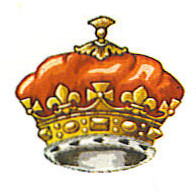
- sons and daughters of heir apparent (1719/1917):
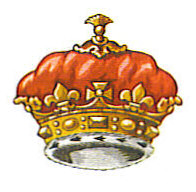
- sons other than dukes (1661) and daughters (?/1917) of younger sons and brothers of the
sovereign:
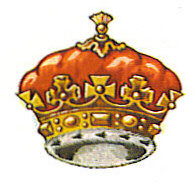
- Highnesses (1911); sons and daughters ("being subjects of these
our realms") of daughters of the sovereign (1917):
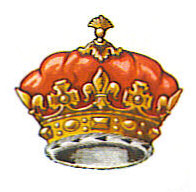
Special cases
Prince Rupert
Prince Rupert (1619-1682) was a son of Elizabeth, daughter of James I,
and the Elector
Palatine, who lost his states during the Thirty Years War. In
1642
Rupert went to England, was made a knight of the Garter on April 19,
1642, duke of Cumberland in 1643, and served as General of the Horse of
his cousin Charles I during
the Civil War. He returned to England at the Restoration, was
made a
Privy Councillor and Vice-Admiral of England, and died in 1682,
unmarried. For his funeral, Charles II issued a warrant on 6
Dec
1682: stating that "whereas the Prince in his lifetime, in relation to
the Palatine family, did bear a peculiar and distinct form of coronet,
from what the said King had ordered for the Royal family, therefore,
taking the same into his consideration, he does thereby order and
decree, that at the funeral of the said prince there shall be used such
a form of coronet as in the margin of the said warrant is depicted"
(Sandford, p. 570). The coronet depicted is the standard coronet
of a
prince of the Holy Roman Empire.
Duke of Cumberland
By
Royal Warrant dated 29 February 1879 Arms, were assigned to the
Duke of Cumberland in which the following passage occurs "And it not
appearing that any Coronet hath hitherto been appropriated to Princes
Cousins of the Sovereign We do further ordain that Our said dear
Cousin shall in future use and bear a Coronet of crosses and flowers or
leaves in every respect similar to that which was assigned to his
father".
The Schleswig-Holsteins, Tecks and Battenbergs
A series of royal warrants of Sep 26, 1910 (sons of Prince and Princess
Henry of Battenberg), Nov 6, 1911 (duke of Teck, Prince Alexander of
Teck), May 14, 1912 (Prince Louis of Battenberg and his children) and
July 25, 1912 (children of Prince and Princess Christian of
Schleswig-Holstein) assigned arms to members of these families.
The following coronets were assigned:
- children of Prince and Princess Christian of Schleswig-Holstein (Highnesses by warrant of May 15, 1867)
- sons of Prince and Princess Henry of Battenberg (Highnesses by warrant of Dec 4, 1886)
- duke of Teck (Highness by warrant of June 9, 1911)
- Prince Alexander of Teck, Prince Louis of Battenberg and his children (Serene Highnesses)
Diplomatics
This section to be completed.